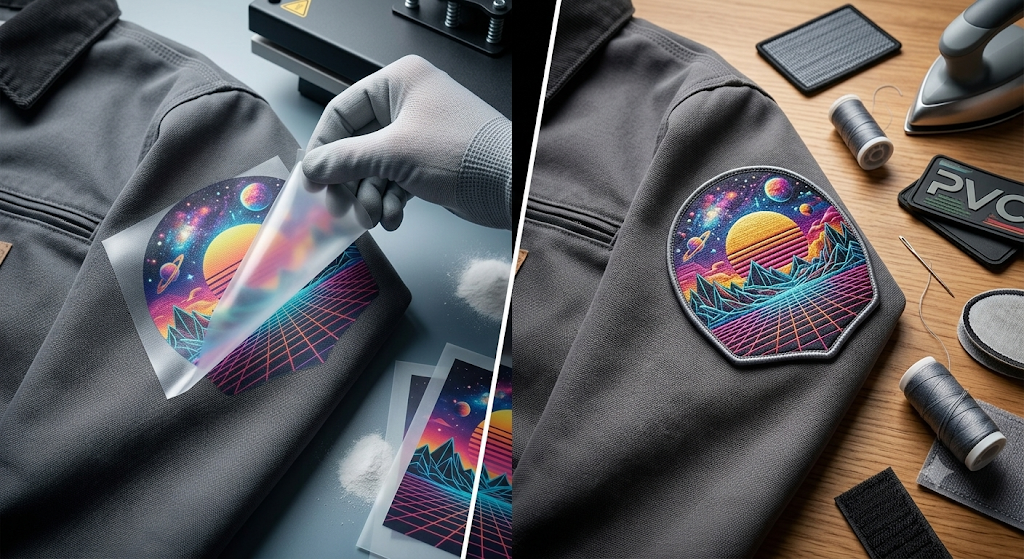
When it comes to decorating apparel, gear, bags, or branded merchandise, two options consistently rise to the top of the conversation: DTF transfers and custom patches. Both can carry your logo, artwork, or design onto virtually any item, but they work very differently and deliver very different results. Knowing which method fits your project, budget, and durability expectations before you place an order can save you significant time and money.
This guide breaks down the real differences between DTF transfers and custom patches across every factor that matters, so you can make a confident, informed choice.
What Are DTF Transfers?
DTF stands for Direct-to-Film. The process involves printing a design onto a special PET film using a dedicated inkjet printer loaded with CMYK inks and a white layer. A hot-melt adhesive powder is then applied and cured, creating a transfer film that can be heat-pressed onto almost any fabric. Unlike screen printing, DTF requires no screens or setup beyond a print file, making it fast and accessible even for single pieces.
The finished result sits on top of the fabric as a flexible, full-color print. When done correctly, the print bonds tightly to the garment fibers, feels soft to the touch, and stretches with the material. DTF technology has advanced rapidly, and quality-produced transfers now wash and wear considerably better than older heat-transfer vinyl methods.
The Eagle Patches USA offers a dedicated DTF Transfer service for customers who need fast, full-color printing without minimums.
What Are Custom Patches?
A custom patch is a self-contained piece of fabric, rubber, leather, or chenille that carries your design and is then attached to a garment or item as a separate element. Patches can be sewn on, ironed on, glued on, or fastened with Velcro, magnetic closures, or safety pins, depending on the backing chosen.
The most common types include embroidered patches (which use thread to recreate a design), woven patches (which weave the design into the fabric), PVC patches (molded rubber for waterproof or tactical use), sublimated patches (full-color printing on a patch substrate), leather patches (premium branding), and chenille patches (plush varsity-style). Each type has its own texture, detail capacity, and ideal use case.
Unlike a DTF transfer, which is bonded directly onto the garment, a patch is an independent object. It can be removed and reapplied if Velcro-backed, or it can outlive the garment itself. If you want to understand how different patch construction methods compare.
DTF Transfer vs Custom Patches: Head-to-Head Comparison
The table below covers the factors most buyers prioritize when choosing between the two decoration methods.
| Factor | DTF Transfers | Custom Patches | Best For |
| Color Range | Unlimited (photographic) | Wide (varies by type) | DTF |
| Durability | Moderate (50+ washes) | High (years of wear) | Patches |
| Texture / Feel | Flat, smooth, soft-touch | Textured, raised, premium | Patches |
| Min. Order Qty | 1 piece (no minimums) | Typically 25-50 pcs+ | DTF |
| Repositionable | No (permanent once pressed) | Yes (Velcro-backed options) | Patches |
| Perceived Value | Moderate | High (collector/merch appeal) | Patches |
| Fabric Compatibility | Most woven fabrics | Any fabric + non-fabric | Patches |
| Production Time | Fast (hours-days) | 1-3 weeks typical | DTF for urgent orders |
Key Differences Explained
1. Durability and Wash Performance
This is where patches hold a clear advantage. A well-made embroidered or woven patch is essentially its own finished textile. It resists washing, friction, UV exposure, and general wear far longer than any printed decoration. Workwear and uniform patches, for example, regularly survive hundreds of wash cycles without fading or peeling.
DTF transfers hold up well for moderate-wear applications, typically lasting 50 or more washes when properly applied, but they are more vulnerable to high heat, repeated abrasion, and improper care than a patch. For uniforms, tactical gear, or any application where the decoration must look sharp over years of active use, custom patches for workwear and safety gear are the more reliable long-term choice.
2. Design Complexity and Color Reproduction
DTF transfers can reproduce virtually any artwork exactly as it appears on screen, including gradients, shadows, photographic images, and designs with dozens of colors, all without extra cost per color. This is a significant advantage for complex illustrations or brand marks that include subtle color blending.
Custom patches handle most logo types very well, but highly photographic designs are best suited to sublimated patches rather than embroidered or woven construction. Standard embroidery works in solid thread colors, which means extremely fine gradients may need to be simplified. If your artwork is already designed for print, a custom sublimated patch bridges the gap by giving you patch durability with full-color print quality.
3. Minimum Order Quantities
DTF transfers have essentially no minimum. You can order a single transfer for a one-off project, personal customization, or product sample. This makes them ideal for small clothing brands testing a design, event organizers who need just a few pieces, or individuals personalizing a single garment.
Custom patches are most cost-effective in bulk. Pricing per unit drops significantly as quantities rise, and setup costs are spread across the order. For brands and organizations planning a consistent uniform or merchandise program, the unit cost of patches at volume typically beats the per-unit cost of DTF transfers at the same scale.
4. Texture, Dimension, and Perceived Value
A patch is a physical object. When someone holds or sees an embroidered patch on a jacket, they recognize it as something intentional, crafted, and premium. The raised texture of embroidered thread, the molded depth of a PVC patch, or the soft plushness of a chenille patch creates a sensory experience that flat printing cannot replicate.
DTF transfers produce a clean, flat, soft-touch result that looks great on the right application, particularly for fashion apparel and print-heavy designs. But for brand merchandise, collector items, or anything where the decoration itself is part of the product’s appeal, a patch carries noticeably higher perceived value. This is why most jacket customization projects, from placing patches on a bomber jacket to equipping club members with an MC set, default to embroidered patches over printed alternatives.
5. Application Flexibility
DTF transfers are permanently bonded to the garment through heat and adhesive. Once applied, they cannot be repositioned without damaging the fabric or the print. This is fine for most apparel decoration, but it means you need to get placement right the first time.
Patches offer more flexibility. Iron-on backed patches are also permanent once applied, but Velcro-backed patches can be removed and reattached to different garments or positions at will. This makes them ideal for military and tactical applications, sports teams, and any organization where members may upgrade or transfer their identifying patches between items.
Which Should You Choose? Use-Case Selector
Not every project falls neatly into one category. Use this quick-reference table to identify which option fits your specific situation.
| Your Situation | Choose DTF Transfers | Choose Custom Patches |
| Small one-off run (1-10 items) | Yes | Not cost-effective |
| Bulk branded merch (50+) | Option for photographic artwork | Best value at scale |
| Uniform / workwear identification | No (durability concern) | Yes – standard choice |
| Photo-realistic artwork | Yes | Sublimated patch alternative |
| Tactical / military gear | No | Yes – PVC or embroidered |
| Fan merch / collector items | Viable for apparel prints | Preferred for high-value merch |
Choosing the Right Patch Type for Your Project
If custom patches are the right fit, choosing the right custom patch is determining which patch type best suits your design and application, but the table below provides a quick-start overview.
| Patch Type | Ideal When You Need… |
| Custom Embroidered Patches | Classic texture, logos, uniforms, and raised thread look |
| Custom Woven Patches | Fine detail, small text, thin flat patch |
| Custom PVC Patches | Waterproof, tactical gear, morale patches |
| Custom Sublimated Patches | Full-color photo artwork on a patch format |
| Custom Leather Patches | Premium branding, hats, denim, upscale goods |
| Custom Chenille Patches | Varsity, letterman, sports, plush feel |
Can You Use DTF Transfers and Patches Together?
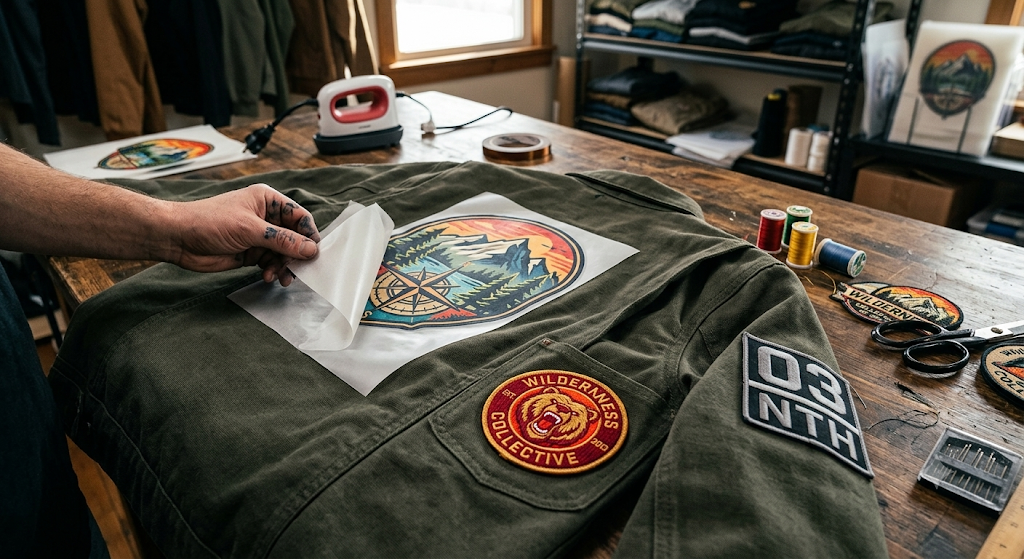
Yes, and it is more common than most people expect. Many clothing brands and event organizers use DTF transfers for the main garment print and custom patches as secondary branding or design elements on the same piece. A jacket, for example, might carry a large back graphic applied via DTF while the chest and sleeve feature embroidered patches with chapter numbers, ranks, or event names.
Similarly, sportswear brands often print player name and number via DTF for speed and customization flexibility, while the team crest or sponsor logo goes on as an embroidered or custom sports patch for durability. The two methods complement each other rather than compete when applied to the right elements of the same garment.
Does Size Affect Your Decision?
Size matters more for patches than for DTF. DTF transfers scale easily from small chest logos to large full-back prints without any change in cost structure. Patches become increasingly expensive to produce at very large sizes due to the amount of material, thread, or rubber required. Understanding the right size for your intended placement can also affect which method makes more economic sense. The custom patch size guide provides practical sizing benchmarks by garment type and placement, which can inform your decision before you finalize an order.
DTF vs DTG vs Custom Patches: Clearing Up the Confusion
Many buyers also encounter DTG (Direct-to-Garment) printing when researching decoration options. DTG prints directly onto the fabric fibers using specialized inkjet heads, whereas DTF prints onto a film that is then transferred. Both are print methods, and both differ from custom patches in the same fundamental way: they decorate the surface of the garment rather than adding a separate element to it. A detailed comparison of DTG vs custom patches for apparel covers that specific question if you are weighing all three options simultaneously.
Cost Comparison: What to Budget For
Custom patches cost is always a deciding factor. Here is a general framework for thinking about price across both methods.
DTF transfers are priced by the print area and quantity. Small transfers at low quantities are very affordable, but per-unit costs do not drop as dramatically with scale as they do with custom patches. DTF also involves a heat-press step, which you can do yourself with equipment or have done by the supplier.
Custom patches have a wider price range depending on type, size, and quantity. Embroidered patches at small quantities (25-50 pieces) represent a moderate per-unit investment, but that cost falls sharply at 100, 250, and 500-piece orders. For a detailed breakdown of what to budget.
Frequently Asked Questions
Are DTF transfers as durable as embroidered patches?
No. DTF transfers are durable for everyday apparel wear and hold up well to regular washing, but they do not match the lifespan of embroidered, woven, or PVC patches. If the decoration needs to look sharp after years of active use and frequent washing, such as on a uniform, work jacket, or tactical vest, a custom patch is the more durable choice.
Can DTF transfers be applied to the same fabrics as patches?
DTF transfers work best on woven fabrics like cotton, polyester, and cotton-poly blends. Patches can be attached to nearly any substrate, including leather, denim, canvas, nylon, and even non-fabric materials. This makes patches more versatile across a wider range of items, from bags to hats to gear.
Which is cheaper: a DTF transfer or a custom patch?
For very small quantities (one to ten pieces), DTF transfers are usually the more affordable option because there are no setup or minimum order requirements. For bulk orders of 50 or more pieces, custom patches often become comparable in cost and may offer better long-term value due to their durability.
Can I use DTF transfers on hats?
DTF transfers can be applied to some structured hats using a curved heat press, but the process is more complex than applying them to flat fabric. Embroidered patches or direct embroidery remain the standard for hat decoration, particularly on structured caps where heat-press access is limited.
Do custom patches require professional attachment?
Iron-on patches can be applied at home with a regular iron or heat press, though a heat press gives more consistent results. Sew-on patches require basic sewing ability. Velcro-backed patches need no tools at all. For professional or commercial applications, having patches applied by a garment decorator ensures consistent placement and lasting bond strength.
What is the minimum order for DTF transfers at The Eagle Patches?
The Eagle Patches offers DTF transfer services with flexible options suited to both small and large runs. Contact the team directly for current pricing and turnaround information specific to your artwork and quantity.
Can I get a patch that looks like a DTF print?
Yes. A custom sublimated patch uses full-color dye-sublimation printing on a patch substrate, giving you photographic print quality in a patch format. This is the closest option to a DTF transfer in terms of color accuracy while still delivering the premium look, feel, and durability of a custom patch.
DTF Transfer vs Custom Patches
DTF transfers and custom patches serve different purposes and excel in different contexts. DTF is the better choice for small quantities, photographic artwork, fast turnaround, and projects where flexibility in quantity is a priority. Custom patches are the better choice for durability, premium brand presentation, repositionable applications, and any project where the decoration is a long-term investment in your brand identity.
Many buyers end up using both within the same product line or garment. The right answer depends on what you are decorating, how long it needs to last, and what impression you want to make on the people who wear or see it. Explore the full range of custom patches available at The Eagle Patches USA, or reach out for a free quote to discuss which solution fits your project best.