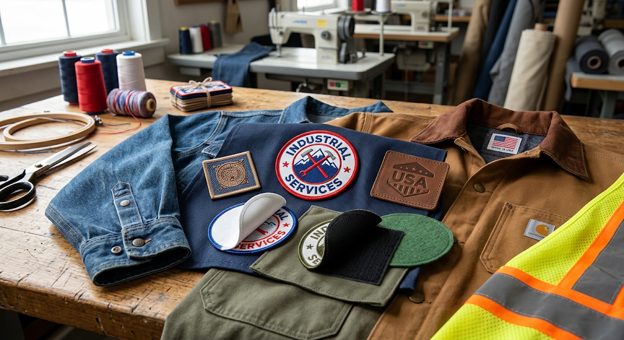
Custom patches for workwear in the USA are supposed to bear rough use, as they get worn daily, so the patch has to survive the job. A patch that looks sharp on day one can get dull or peel within a few weeks if the material or backing is wrong.
Your three choices can decide how long a patch lasts, which are the material, the backing, and the size. This guide has got you covered on each, so you can pick work uniform patches that suit your work gear and handle your wash routine.
Which Patch Material Works on Workwear?
For workwear, a patch should be durable and last a long time, and handle daily and rough use. The following are common materials that will suit your workwear well.
Embroidered patches
Custom embroidered patches are made of fabric, with designs stitched onto it using thread. This gives them a slightly raised texture, which makes them look neat, suit a professional environment, and carry the design well over time through rough use. This makes the embroidered workwear patches a common choice for uniforms.
Woven patches
Woven patches are made on a loom with very fine thread, so they suit logo patches for workwear that have small text or thin lines. They lack the raised texture of stitching, so the logo looks smoother and a little less bold.
PVC patches
PVC patches are made of a flexible plastic with a rubber-like feel. They are molded rather than stitched, so water, mud, and oil stay on the surface. That suits crews who work outdoors or around grease, and the patch wipes clean at the end of a shift.
Leather patches
A leather patch carries a pressed, raised, or laser-etched design. It gives a work jacket, cap, or tool bag a heritage look. It is not the pick for shirts that go through hot, frequent washes.
Material comparison at a glance
The following table states which material you should choose, when, and what to look out for.
| Material | Look and feel | When to choose | Durability | Watch out for |
| Embroidered | Raised stitching on twill | For a classic, textured look with bold logos. | Durable with proper care and stitching. | Tiny text can blur. |
| Woven | Flat and sharp | detailed designs and small lettering. | Durable for regular use, depending on the fabric and construction. | Less texture than embroidery. |
| PVC | Smooth, molded, rubber-like | flexible, weather-resistant patch. | Highly durable and resistant to moisture. | Can feel stiff; pricing varies by design. |
| Leather | Pressed, raised, or etched | classic, premium look. | Durable with suitable care. | Not ideal for hot washing or frequent machine washing. |
Which Backing Should You Choose for Work Uniform Patches?
How long the patches stay attached to the fabric depends on the backing, so you have to decide carefully.
Sew-on: the safer pick for hard-washed shirts
A sew-on patch can work without any glue. They are quite tricky to attach because not everyone is good at sewing, but they are a lasting way to attach a patch.
How to Sew on a Patch
- Place the patch where you want it.
- Use pins to keep it in place.
- Thread a needle and sew around the patch’s edges.
- Tie a knot to secure the thread on the inner side of the fabric
- Trim any extra thread.
Down side
- It can leave holes in the fabric if you remove it.
Iron-on: quick, but light-duty
An iron-on patch comes with a heat-activated layer of glue, all you have to do is press the patch with an iron. The glue will melt and bond with the fabric, it is not as lasting as sewing, but it is the easiest one.
How to Iron on a Patch
- Check that the fabric can handle heat.
- Place the patch on the fabric with the adhesive side facing down.
- Cover it with a thin cotton cloth.
- Press with an iron according to the patch maker’s instructions.
- Let the patch cool before checking that the edges are secure
Down side
- The patch can peel if the garment is washed often.
- Synthetic fabric, like nylon,n can get damaged while ironing a patch.
Hook-and-loop: for patches you want to remove
Hook-and-loop, often called Velcro, consists of two strips that can attach and detach, giving you the flexibility to swap patches whenever you want. The hook strip is attached to the patch, while you have to sew the loop strip to the garment.
How to Attach a Hook-and-Loop Patch
- Attach the soft loop side to the garment or surface.
- Attach the rough hook side to the back of the patch.
- Press the two sides together firmly.
- Pull the patch apart when you want to remove or replace it
Down side
- Lint can collect on the hook side, which causes its grip to loosen.
Adhesive, safety pin, and magnetic backings
- Adhesive backing is a peel-and-stick layer; it works like a sticker. Thus, it suits short events better than daily wear and might leave a sticky residue.
- A safety pin backs temporary badges, which you can wear and remove. It can leave holes, and the patch can move since it is not fixed to the fabric.
- Magnetic backing holds a patch without a stitch or a glue layer, which helps on uniforms where you want no holes, though the patch can fall off due to friction.
Backing comparison at a glance
| Backing | How it attaches | Suits | Watch out for |
| Sew-on | Stitched on by hand or machine | Hard-washed shirts and jackets | Takes sewing time |
| Iron-on | Heat-activated glue | Light-duty items | Heat can harm some fabrics |
| Hook-and-loop | Hook strip on the patch, loop strip sewn on | Patches you swap or remove | Close the hooks before washing |
| Adhesive | Peel-and-stick | Short-term use | Not meant for daily wear |
| Safety pin | Pinned on | Temporary badges | Pierces the fabric |
| Magnetic | Magnets hold it in place | Removable badges | Check the hold on thick fabric |
What Size Should Workwear Patches Be?
Patch size follows placement because you cannot put a back patch on the pocket. Every place on the garment requires a different size. The following table is provided to help you understand how large a patch should be, depending on its placement.
| Placement | Common size | Note |
| Left chest | About 3 to 4 inches wide | A usual spot for a company logo |
| Sleeve | About 2 to 4 inches wide | Keep it clear of the seam |
| Name patch | About 1 inch tall, 3 to 4 inches wide | Longer names need more width |
| Cap front | About 2 to 3 inches wide | Must curve with the crown |
| Jacket back | About 8 to 12 inches wide | Room for a large logo |
Can You Put Patches on Hi-Vis or Flame-Resistant Workwear?
Yes, but check the rules first. Rules vary by garment class and workplace. Ask your safety lead or garment maker before ordering.
Hi-vis vests and shirts
The US standard for high-visibility safety apparel sets minimum areas of bright background fabric and reflective material for each garment class. A logo made from material that does not meet the standard can count against those areas. So make sure you know the criteria for hi-vis before you order a patch.
Flame-resistant workwear
Flame-resistant (FR) workwear is made to resist burning and protect the wearer from heat. Standard patches are not heat-resistant and can add burnable material to the garment. So ask for the patches to be made of heat-resistant material.
How Does Ordering Work?
Ordering takes three steps. For company uniform patches, tell us the garment fabric, how it is washed, and where the patch will sit. That one detail lets us steer you toward the right backing.
- Send your logo or sketch. A rough drawing is fine.
- Review your free mockup. We build the design at no charge. Change colors, thread, and layout until it looks right because it saves you from ordering the whole new batch.
- Approve and wait 7 to 10 days. We make your patches in the USA and ship on time, free of charge.
Frequently Asked Questions
Can I order a small batch of patches for a crew?
Yes, eagle patches have no minimum order, so you can order for a handful of people.
How long does it take to get workwear patches?
Turnaround time is 7 to 10 business days. If you want to receive your patches faster, we also offer rush delivery.
Do I need a finished design file?
You can send your idea or sketch, and our team can turn it into a professional design at no extra charge.
Do patches work on thick fabrics like canvas or denim?
Yes, sew-on patches work well on canvas and denim if you use a heavy-duty needle. Iron-on patches may not last well on thick or textured fabric.
Should I choose patches or direct embroidery on uniforms?
Patches are the flexible choice because you can replace or move them, direct embroidery does not give you that freedom.
How should I wash workwear with patches on it?
Turn the garment inside out before putting it into a cold wash. Air-drying is a better option, as the heat from the dryer can weaken the patch’s glue and threads.
Choosing the Right Custom Patches for Workwear
Choosing uniform patches for workwear requires a little extra care and some standards when it comes to hi-vis and flame-resistant workwear. Commonly preferred materials include embroidery, woven fabrics, PVC, and leather, which work best for uniforms. Choose the right backing and size as well.
To get started, you can request a free quote with your logo and garment details. The Eagle Patches team will assist you and will send you a free mockup before anything is made.