Custom patches help to show off love for a particular band, increase brand/club identity level, or add a personal touch to various items. So, one should first familiarize oneself with the options available.
Different types of custom patches exist, such as PVC patches, which are made from polyvinyl chloride, leather patches, which are made from animal hide, and chenille patches, which have a fuzzy texture created by looping yarn.
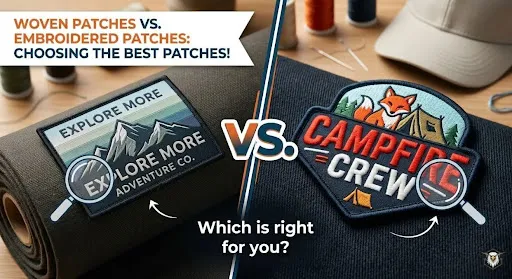
The two most common among other custom patch types are woven patches and embroidered patches. Both are made differently. Woven patches are stronger than embroidered patches and can handle intricate (complex) designs while embroidered patches usually are usually not a great fit for complicated design elements.
You might end up with a patch design that looks wrong, or in the worst case, the patch can disintegrate if the right choice is not made. This article is designed to educate the reader on the differences between woven patches vs. embroidered patches so that you will be able to determine which type of custom patch to opt for.
Deciding Between Woven Patches vs. Embroidered Patches
Among other custom patch types, the two that are widely used and recognized are the woven patches and the embroidered patches. Choosing the right one between them is confusing and can make even the pros scratch their head.
So, we decided to end this debate and help people understand and select the one that is best for their design type and usage.
Understanding Embroidered Patches: The Classic Choice
When you try to think of a traditional uniform patch or maybe a vintage biker patch, you are mostly thinking of embroidered patches.
How They Are Made
Embroidered patches are made by sewing rayon or polyester threads onto a fabric. This fabric is usually a type of twill. A machine that is controlled by a computer does the sewing. It creates the design by sewing the thread onto the fabric. Embroidered patches have a raised texture because of how they are made.
The Key Characteristics
- 3D Texture: As the thread is layered, the design has a physical pop and weight to it.
- Traditional Look: They offer a classic, high-quality look that feels significant.
- Thread Thickness: The threads used are relatively thick.
Best For
Embroidered patches are best for simple yet bold designs, like the following ones:
- Sports team logos
- Police and fire department uniforms
- Military morale patches
- Vintage-style fashion branding
Understanding Woven Patches: The Detailed Alternative
While they have gained massive popularity over the recent years, many people still are unfamiliar with how woven patches differ from their embroidered alternatives.
How They Are Made
Woven patches are different from embroidery patches. With embroidery, you stitch thread onto a piece of fabric. With woven patches, you weave really thin threads together on a special machine called a loom. This way, you make the patch from scratch.
The Key Characteristics
- Fine Detail: Because the threads are much thinner, they can achieve fine details and crispness.
- Flat Surface: These patches have a smooth and flat feel, lacking the 3D rise of embroidery.
- Thin and Flexible: They are generally lighter and more flexible, making them ideal for lightweight apparel.
Best For
Woven patches shine when the design is complex, such as
- Small text that is highly readable on woven patches
- Complex logos with color gradients or realistic elements
- Merchandise for bands, artists, or tech companies
- Application on thin fabrics like t-shirts or technical outerwear
Head-to-Head: Woven vs. Embroidered Patches
To help you make your final decision, let’s compare them across four key categories.
1. Level of Detail
This is the thing that sets them apart. If your design has small text, like under 4 mm, thin lines, or complicated patterns, then woven patches are the best option. The thin threads in woven patches make it possible to have complex details on the patch.
If your design is basic and has thick lines, embroidered patches are a good choice. They have a look with a lot of texture that many people like. Embroidered patches are good for textured designs. Woven patches are suitable for complex designs.
Winner for Detail: Woven Patches.
2. Texture and Appearance
Do you want your patch to really stand out from across the room, or do you simply want to hide some mishap? Embroidered patches are special because they have a raised texture that you can see and feel. It is like a bump, and they catch the light and look heavy.
Do you like patches that are simple and modern? Woven patches are flat and smooth. They look neat and clean and offer complex designs.
Winner for Texture: For texture, choose embroidered patches if you want a 3D raised feel. Woven patches can be chosen if you want smoothness.
3. Durability and Application
Both types of patches last a long time with different feel and texture. You can use iron-on or sew-on to apply the two patches depending on convenience and goal.
Embroidered patches are thick and stiff. That makes them suitable for jackets, backpacks, and hats. Occasionally they look too big on a thin T-shirt.
Woven patches are thin and flexible. They attach securely to clothes. That makes them perfect for sportswear, hats, and light fabrics.
Winner for Versatility: Tie, as it depends on the garment.
4. Cost
The prices of the two are much the same. If you are ordering a massive batch, woven patches can be a better deal. This is because it does not take long to make them once everything is ready to go, and they use less thread overall than embroidery. Woven patches are a choice for bulk orders because the manufacturing process for woven patches is faster.
Winner for Budget: Woven patches cost slightly less for bulk orders.
The Verdict: Which Should You Choose?
In the battle between woven vs. embroidered patches, there is not a single winner. The best patch type depends completely on your design and how you are planning to use it.
Choose Embroidered Patches if:
- You want a classic, traditional look.
- Your design has bold lines and minimal colors.
- You want a raised, 3D texture.
- You are applying them to heavy fabric like denim or canvas.
Choose Woven Patches if:
- Your design includes small text or complex details.
- You prefer a clean, thin, and flat finish.
- You are applying them to lightweight apparel like t-shirts or activewear.
- You want detailed and modern aesthetics.
FAQs
What are embroidered patches?
Embroidered patches are classic and traditional custom patches created by stitching rayon or polyester threads onto a base fabric such as twill.
What are woven patches?
Woven patches are made by weaving together thin threads on a loom. They are made entirely from scratch.
What patch works best for my special logo with small text?
Woven patches, unlike embroidered patches, have thinner threads that can be useful in making custom patches with complex design logos and tiny text, keeping them readable.
Which patch is cheaper between embroidered and woven ones?
Woven patches in bulk are generally cheaper than embroidered patches, as they use less thread comparatively.
Ready to Order Your Custom Patches?
After reading the guide above, now you know the two most popular types of custom patches, the woven and the embroidered. You know about their texture, feel, and cost.
Still not sure if your design will look as appealing on an embroidered or a woven patch? The solution is to take help from the team at The Eagle Patches USA. We help you choose correctly between a woven patch or an embroidered patch to match your design. We make patches that are durable and made of the finest quality.
We offer free quotes and mockups for the custom patches you demand for your design. Inquire today!