Table of Contents
|
Why Knowing Which Motorcycle Patches to Avoid Matters
Picture this: you pull into a roadside diner somewhere off Interstate 40. You’re wearing a vest you picked up at a flea market, covered in cool-looking patches. A group of leather-clad riders at the back table keeps glancing your way, and not in a friendly manner.
What you might not realize is that one of those patches on your vest belongs to a motorcycle club that earned it through years of loyalty, rides, and brotherhood. And you just walked into their territory wearing it.
Motorcycle patch culture in America runs deep. Since the post-World War II era, patches have been far more than decorative fabric, they are badges of honor, symbols of belonging, and in some cases, marks of power that carry very real-world consequences. Wearing the wrong motorcycle patch, whether out of ignorance or carelessness, can put you in genuine danger, expose you to legal trouble, or permanently damage your reputation in the riding community.
This comprehensive guide covers every category of motorcycle patches to avoid, explains why they are off-limits, and shows you what you can wear to express yourself on the road without stepping on anyone’s colors.
Understanding Motorcycle Patch Culture in the USA
Before diving into which patches to avoid, it helps to understand the language of motorcycle patches, because in biker culture, patches are a language.
The modern motorcycle patch system in America largely grew out of the club culture that emerged in the late 1940s and 1950s. Veterans returning from World War II formed riding clubs modeled on the camaraderie and structure of military units, and they brought with them the tradition of custom military patches to identify their unit and rank. Those early riding clubs eventually gave rise to the structured, hierarchical system of motorcycle club patches we see today.
In this system, every element of a patch, its shape, colors, text, position on the vest, and even the number of pieces, carries meaning. A patch is not just decoration. It is a declaration of identity, allegiance, and status within a community that takes those declarations very seriously.
The Basic Patch Hierarchy
| Patch Type | Who Wears It | Typical Structure |
| One-Piece Patch | Independent riders, riding associations, families | Single emblem, no rockers |
| Two-Piece Patch | Riding clubs (RC), clubs in development | Center logo + one rocker |
| Three-Piece Patch (Colors) | Full motorcycle clubs (MC) | Center logo + top rocker + bottom rocker |
| 1% Diamond Patch | Outlaw or “outlaw-identified” MC members | Small diamond with “1%” or “1%er” |
| Support Patch | Associates/supporters of a specific MC | Club name + “Support” or “Friends” |
Understanding this hierarchy is the foundation of knowing which motorcycle patches to avoid.
The Top Motorcycle Patches to Avoid (And Why)
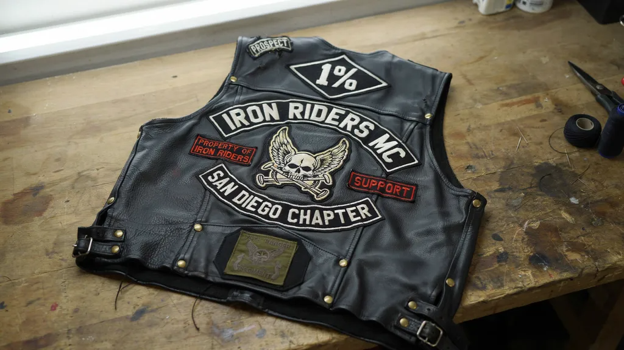
Here is the complete breakdown of every category of motorcycle patch that non-members or unaffiliated riders should never wear, along with the reasoning behind each restriction.
The 1% Diamond Patch — The Most Dangerous Patch to Wear Incorrectly
Risk Level: EXTREME
The “1%” or “1%er” diamond patch is perhaps the single most dangerous motorcycle patch to wear without authorization in the United States.
The legend behind it traces back to a 1947 motorcycle rally in Hollister, California, after which the American Motorcyclist Association (AMA) reportedly stated that 99% of motorcyclists were law-abiding citizens. Outlaw motorcycle clubs embraced the “1%” label as a badge of defiance, declaring themselves the remaining one percent who operate outside mainstream society.
Today, wearing a 1% patch without affiliation to a recognized outlaw MC is not just disrespectful, it is perceived as a direct challenge or a fraudulent misrepresentation. Clubs that earned this patch through years of commitment protect it fiercely. The consequences for wearing it without membership range from a very uncomfortable conversation at a minimum to serious physical danger.
What it looks like: A small diamond-shaped patch, typically with “1%” or “1%er” written on it, often worn on the front of the vest.
Why people mistakenly wear it: It shows up in motorcycle gear shops, online marketplaces, and novelty stores. People sometimes buy it thinking it’s just a cool biker symbol without understanding its loaded meaning.
The rule: Never wear a 1% patch unless you are an initiated member of a club that uses it. Full stop.
Three-Piece Patches (MC Colors) — Never Wear Without Earning Them
Risk Level: EXTREME
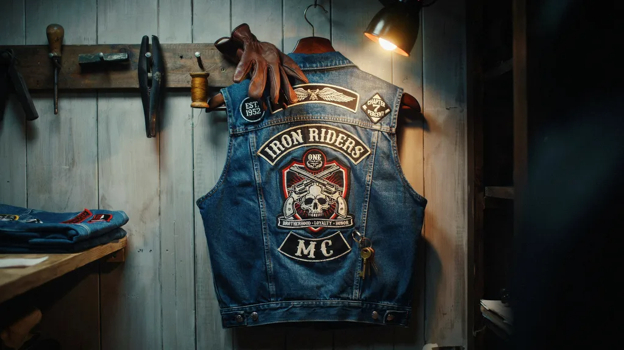
The three-piece patch, also called “colors” or a “cut,” is the formal uniform of an established motorcycle club. It consists of:
- Top Rocker: The club name, arcing across the top of the back of the vest
- Center Patch: The club’s main logo or emblem
- Bottom Rocker: The territory or chapter location, arcing across the bottom of the back
This is the most sacred territory in patch culture. Three-piece colors represent years of prospecting, initiation, loyalty, and brotherhood. They are awarded, never bought, and they belong to the club, not the individual. When a member leaves, their colors are returned to the club.
Wearing a three-piece patch design (even a fictional one that mimics the format) without legitimate MC membership is considered an extreme violation of biker etiquette. Established MCs actively monitor their territory for “patch posers,” and the encounter will not be pleasant.
Common mistake: Buying a vest online that comes pre-patched with a three-piece design for a fictional or generic club, not realizing that the three-piece format itself is considered off-limits for non-MCs.
The rule: Do not wear a three-piece patch configuration unless you are a full member of a registered, legitimate MC.
Club-Specific Name and Logo Patches
Risk Level: HIGH
This should be obvious, but it is worth stating clearly: never wear the name or logo of a specific motorcycle club unless you are a member of that club. This applies to:
- Hells Angels patches and Death Head logo
- Bandidos patches
- Mongols MC patches
- Outlaws MC patches
- Pagans MC patches
- Vagos MC patches
- Any regional or local MC’s name or emblem
These patches are intellectual property of their respective clubs (and some, like the Hells Angels, are even registered trademarks). More importantly, wearing them signals to every rider you encounter that you are claiming membership you did not earn. This is called “patching over” territory, and it is taken extremely seriously.
Many well-known clubs have been involved in legal disputes over their logos, names, and color combinations precisely because their visual identity is central to their power and recognition.
What about vintage patches or collector patches? Even wearing a vintage patch from an established club as a “collectible” on your vest is inadvisable. The context in which the patch is displayed matters more than your intention.
Support Patches for Outlaw MCs
Risk Level: HIGH
Support patches, also called “support gear”, identify the wearer as an associate, friend, or supporter of a specific outlaw MC without being a full member. Examples include patches with phrases like “[Club Name] Support,” “Property of [Club Name],” or the club’s colors with a “Support” designation.
These patches are NOT sold in stores. They are given by the MC to people within their circle of trust. Wearing them without that relationship is a serious breach and signals to the club that you are either dangerously naive or deliberately disrespectful.
Additionally, wearing support patches for outlaw clubs can draw law enforcement scrutiny. In the USA, support clubs and gear are often documented by agencies like the ATF and FBI as part of their monitoring of organized motorcycle clubs.
The rule: Never purchase or wear support gear for any established MC. These items should only be received directly from the club.
Law Enforcement & Military Impersonation Patches
Risk Level: LEGAL DANGER
This category crosses the line from cultural disrespect into legal territory. Wearing patches that falsely represent yourself as a law enforcement officer, including fake police badges, DEA or FBI patches, Sheriff’s patches, or U.S. Marshal insignia, can violate federal and state laws against impersonating a law enforcement officer.
Similarly, wearing military patches you did not earn, such as medals, special forces insignia (Navy SEAL, Army Ranger, Green Beret patches), or unit patches from specific combat deployments, can potentially violate the Stolen Valor Act of 2013, which makes it a federal crime to fraudulently claim military honors or distinctions.
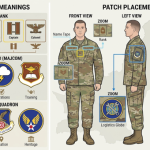
What is allowed: Genuine veterans wearing patches from their own service. Custom patches that reference military service in a non-deceptive, clearly personal way.
What is NOT allowed: Wearing military unit patches, rank insignia, or medals you did not earn. Wearing any patch that could lead a reasonable person to believe you are a law enforcement officer.
| Category | Specific Examples | Legal Risk |
| Police impersonation patches | Sheriff star, “Police,” “Detective” | Criminal charges for impersonation |
| Federal agency patches | DEA, ATF, FBI, U.S. Marshal | Federal impersonation charges |
| Unearned military honors | Purple Heart, MOH, SEAL Trident | Stolen Valor Act violation |
| Unearned combat unit patches | 75th Ranger Regiment, Special Forces | Potential Stolen Valor violation |
| Fictional “tactical” police patches | Overly realistic “SWAT” patches | Context-dependent legal risk |
Territory and Bottom Rocker Patches
Risk Level: HIGH
Even if you are part of a legitimate riding club or association, wearing a bottom rocker that claims a state or city as your territory, when that territory is already claimed by an established MC, is a significant violation.
In MC culture, territory is everything. Clubs have long-standing claims over geographic areas, and riding through “claimed” territory with a competing bottom rocker on your vest is interpreted as a direct challenge to that club’s dominance. This is especially true in states like California, Texas, Florida, and New York, where multiple large MCs have historically overlapping territorial interests.
What non-MC riders can do: If you are part of a riding club or association and want to wear location-identifying text, use your home city or region in a format that clearly does not mimic the bottom rocker format, such as incorporating it into a single-piece patch design.
“Prospect” and “Hangaround” Patches
Risk Level: MODERATE-HIGH
The prospect and hangaround stages are the entry points into most MCs. A prospect is actively working toward full membership; a hangaround is someone being considered for prospecting. Both wear specific patches to identify their status within the club.
Wearing a “Prospect” patch for a specific club without actually being in that club’s pipeline is considered an impersonation. It also marks you as someone who doesn’t understand the culture deeply enough to be trusted.
Additionally: The word “Prospect” on a generic or novelty patch is sold widely in stores. While less dangerous than wearing club-specific prospect patches, wearing it in riding community spaces can still draw unwanted attention or questions.
Honorary Membership Patches
Risk Level: MODERATE
Some MCs give out honorary membership or honorary citizenship patches to law enforcement, politicians, or celebrities as a public relations gesture. These are formal designations given by the club and are not available for purchase.
Wearing a fake or self-designated “honorary member” patch of any established club will be seen as fraudulent by that club and by the wider MC community.
What Happens If You Wear the Wrong Motorcycle Patch?
Depending on the severity of the violation and the club involved, the consequences can range widely:
- A verbal confrontation: You will be asked to remove the patch. This is the best-case scenario and is most common with less aggressive clubs or when the violation appears genuinely accidental.
- Forced removal: In a more assertive club culture, the patch may be physically removed from your vest on the spot.
- Being “patched over”: Your entire vest may be confiscated, especially if it contains three-piece colors that belong to or mimic a real club.
- Being barred from events: You may be permanently banned from certain rallies, bars, or biker events in a given region.
- Physical confrontation: In the most serious cases, especially involving outlaw MCs, wearing their patches without authorization can escalate to violence.
- Legal consequences: If your patches impersonate law enforcement or involve Stolen Valor situations, you could face arrest and criminal charges.
The motorcycle community values respect above nearly everything else. The vast majority of situations that escalate do so not because of the original mistake, but because the person wearing the patch becomes defensive when confronted. The right response is always respectful acknowledgment and immediate compliance.
Patches Non-Members Can Safely Wear
Here is the good news: the world of motorcycle patches is enormous, and there is no shortage of expressive, meaningful patches that any rider can wear proudly without any cultural or legal concerns.
Safe Patch Categories for Independent Riders
- Personal Achievement and Milestone Patches
Patches celebrating your own riding milestones, 10,000 miles ridden, Iron Butt Association completion, specific routes or trails, are universally respected and entirely yours to wear.
- Charity and Cause Riding Patches
Patches from organized charity rides such as Toys for Tots motorcycle runs, veterans’ benefit rides, cancer awareness events, and similar causes are welcomed across the entire riding community. These custom embroidered patches are often given to participants upon completion of the ride.
- Commemorative Event Patches
Sturgis, Daytona Bike Week, Laconia Motorcycle Week, and hundreds of other rallies issue commemorative patches each year. These are available to all attendees and are a beloved tradition of building out a vest over years of events.
- Manufacturer and Brand Patches
Harley-Davidson H.O.G. (Harley Owners Group) patches, Indian Motorcycle Riders Group patches, BMW Motorrad Club patches, and similar brand-affiliated club patches have their own structure and rules, but are generally accessible to registered members of those organizations and carry no outlaw MC connotations.
- Custom Personal Patches
This is where riders can truly express themselves. Custom motorcycle patches featuring your own design, nickname, hometown, personal philosophy, or artwork are completely within bounds. A custom patch you designed and had made says exactly what you want it to say, and no one else has it.
- Humor and Novelty Patches
humorous, irreverent, or funny patches are a beloved part of rider culture and carry no territorial meaning. Expressing identity and team Spirit with morale patches has also become a part of the motorcycle club culture.
- Veterans and Service Patches
If you served, wear it with pride. Your branch of service, unit designation (that you actually served in), deployment patches, and campaign ribbons are all honors you earned and have every right to display.
- One-Piece Club Patches
If you are a member of a riding club (RC) or motorcycle riding association (MRA) that uses a single-piece patch format, these are widely accepted. Riding clubs using the one-piece format signal that they are a social or recreational group rather than a territorial MC.
Motorcycle Patch Placement Rules You Need to Know
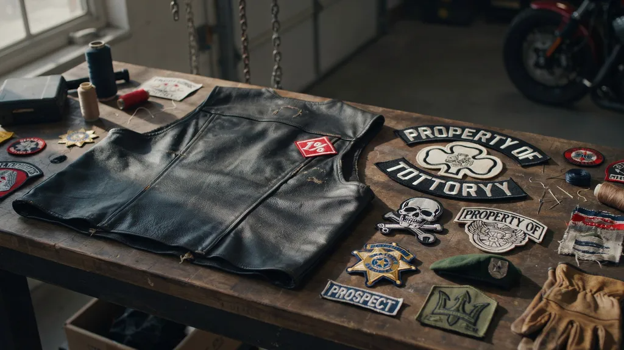
Even with patches you are allowed to wear, placement matters. The back of a motorcycle vest is prime real estate with unwritten rules:
| Location on Vest | What Goes There |
| Center back (large) | Club or personal center patch / main design |
| Top of back | Top rocker, club name (MC members only) |
| Bottom of back | Bottom rocker, territory (MC members only) |
| Front left chest | Club name tag, rank, or personal name patch |
| Front right chest | Office or position patch, event pins |
| Left shoulder | State flag, nationality, military branch |
| Right shoulder | Event patches, rally patches |
| Collar area | Small pins or mini patches |
For independent riders not affiliated with an MC, a single large back patch with a one-piece design is the cleanest, safest, and most universally respected choice. They should always check the guide to motorcycle patches before buying a patch.
The Difference Between MC, MCC, and RC Patches
One of the most common sources of confusion, and accidental patch violations, is the difference between the three main types of riding organizations and their patch conventions.
| Term | Full Name | Patch Format | Territorial Claims | Hierarchy |
| MC | Motorcycle Club | Three-piece (colors) | Yes, strongly enforced | Full club structure, President, VP, SGT-at-Arms, etc. |
| MCC | Motorcycle Club / Christian Motorcyclists Association-style | Often two-piece or one-piece | Generally informal | Looser structure, often themed around faith or charity |
| RC | Riding Club | One-piece | No | Social/recreational, no formal territorial claims |
| MRA | Motorcycle Riders Association | One-piece | No | Advocacy or brand-based groups |
If you are forming or joining a riding group and want to create patches, use the one-piece format to clearly signal your non-MC status and avoid any territorial confusion. Our custom motorcycle patches service can help you design a professional one-piece patch that represents your group without any of the baggage.
How to Design Your Own Safe, Custom Motorcycle Patches
Making a Custom Patch is easy. The safest, most satisfying, and most personal option for any rider is designing their own custom patches. A patch that you created, with your own artwork, your own nickname, your own story, belongs to you completely. No club can challenge it. No cultural rule applies to it. It is yours.
Here is what to consider when designing a custom motorcycle patch:
Format: Stick to One-Piece
Unless you are an official MC creating your formal colors, design your primary back patch as a single unified piece rather than three separate rockers. This clearly communicates your independent status and ensures no one mistakes you for claiming MC membership or territory.
Materials: Choose for Durability
Motorcycle gear takes a beating. The best materials for patches that will live on a riding vest or jacket are:
- Custom embroidered patches: The gold standard of motorcycle patch tradition. Thick thread, raised texture, and a classic look that honors biker heritage.
- Custom woven patches: Ideal when your design has fine detail, small text, or a photographic-quality image. The finer weave captures more detail than standard embroidery.
- Custom PVC patches: The toughest option. Fully waterproof, UV-resistant, and nearly indestructible. Great for riders who spend a lot of time in harsh weather.
- Custom leather patches: For a premium, rugged aesthetic that ages beautifully and complements leather vests perfectly.
Design Tips for Motorcycle Patches
- Keep text bold and readable from a distance, you want people to be able to read your patch when you’re on the road
- High-contrast color combinations (black and white, black and orange, black and yellow) are the most readable
- Limit complex gradients in embroidered designs, the thread medium works best with solid or semi-solid color fills
- Include a border to give the patch a clean, professional finish
- Consider a die-cut shape (not just a rectangle) for a more dynamic look, shields, circles, skulls, eagles, and flames are classic motorcycle patch shapes
For professional guidance and a free design consultation, contact The Eagle Patches, we specialize in custom motorcycle patches and understand both the technical and cultural requirements of great riding gear.
Attachment Methods
How you attach your patches also matters for longevity:
- Sew-on: The most durable method. Used by serious riders and required by most MCs for their official patches.
- Iron-on: Convenient for lighter vests and denim, but the adhesive weakens over time with heat exposure from riding.
- Velcro backing: Popular for custom morale patches and tactical-style gear where patches need to be swappable.
Additional Patches to Be Cautious About
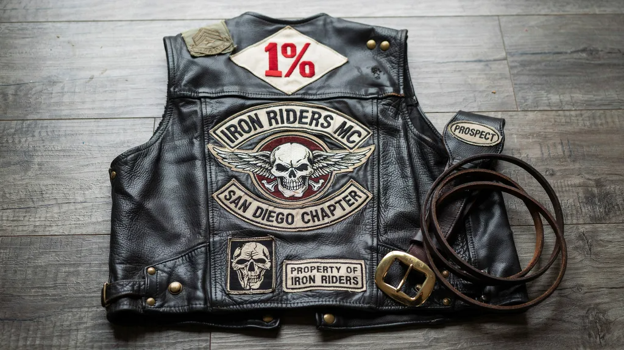
Beyond the core categories above, here are additional patch types that independent riders should approach with caution:
“F.T.W.” and Outlaw Slogan Patches
Phrases like “F.T.W.” (a profane outlaw biker slogan), “Outlaw,” “1%er,” or club-affiliated slogans are deeply tied to the outlaw MC world. Wearing them signals affiliation or sympathy that you may not be able to back up.
Patches Referencing Other Riders’ Deaths (R.I.P. Patches for Strangers)
R.I.P. memorial patches are among the most personal patches a rider can wear. Creating or wearing one for someone you did not personally know, especially if that person was a club member, can be seen as disrespectful to that person’s memory and club.
Counterfeit or Replica Club Patches
Online marketplaces occasionally sell replica patches of famous MCs (often listed as “novelty” or “costume” items). These are universally considered disrespectful and, in some cases, illegal. Even if you intend to use them as a wall display or costume piece, be aware of the risks of displaying them in riding community contexts.
Patches from Dissolved or “Patched Over” Clubs
Some clubs no longer exist because they were absorbed (“patched over”) by larger clubs. Wearing patches from a club that was patched over is seen as dishonoring the dominant club’s history and authority.
Quick Reference: Motorcycle Patches Danger Chart
| Patch Type | Can Non-Members Wear? | Risk Level |
| 1% Diamond | No | Extreme |
| Three-piece MC colors | No | Extreme |
| Specific MC name/logo (e.g., HA, Bandidos) | No | Extreme |
| Support/Property patches for outlaw MCs | No | High |
| Bottom rocker claiming territory | No | High |
| Top rocker in MC format | No | High |
| Law enforcement patches (realistic) | No | Legal danger |
| Unearned military honors | No | Stolen Valor risk |
| Prospect/Hangaround patches for real clubs | No | Moderate-High |
| Honorary membership patches | No | Moderate |
| F.T.W. and outlaw slogans | Caution | Moderate |
| Personal custom one-piece patches | Yes | None |
| Event and rally commemorative patches | Yes | None |
| Charity ride patches | Yes | None |
| Manufacturer/HOG-style club patches | Yes (if member) | None |
| Humor/novelty patches | Yes | None |
| Veterans service patches (earned) | Yes | None |
| One-piece riding club patches | Yes | None |
Frequently Asked Questions
What motorcycle patches are illegal to wear in the USA?
There are two main categories of motorcycle patches that carry actual legal risk in the United States. First, patches that impersonate law enforcement, such as realistic police badges, DEA or FBI insignia, or Sheriff’s patches, can violate state and federal laws against law enforcement impersonation. Second, wearing military medals, decorations, or special unit insignia that you did not earn can potentially violate the Stolen Valor Act of 2013, a federal law. Beyond these legal categories, many other patches (like MC colors and 1% patches) are not illegal to wear per se, but carry serious social and physical risks in the riding community.
Can I wear a 1% patch if I’m not in a motorcycle club?
No. This is one of the most important motorcycle patches to avoid if you are not an initiated member of a club that uses that designation. The 1% patch is not a novelty or a fashion statement, it carries a specific, serious meaning in the outlaw motorcycle community. Wearing it without a legitimate membership will be seen as either extreme ignorance or a deliberate provocation. Either way, the consequences can be severe.
What is the “81” patch, and should I avoid wearing it?
“81” is a number patch worn by members of the Hells Angels Motorcycle Club, “H” is the 8th letter of the alphabet, and “A” is the 1st. It is also sometimes worn as “support” gear by affiliates. This is absolutely a patch to avoid if you are not a Hells Angels member or formally recognized affiliate. Even wearing it unknowingly marks you as impersonating or supporting one of the most well-known MCs in the world.
Is it disrespectful to wear a Hells Angels patch?
Yes, extremely so. The Hells Angels MC is one of the oldest and most widely recognized motorcycle clubs in the world, and their patches, including the Death Head logo, the HAMC initials, the “81” patch, and their chapter rockers, are their exclusive property. The club has even registered these as trademarks. Wearing them without membership is disrespectful to the club, their history, and the brotherhood they represent. It can also lead to direct confrontation.
Can a non-club member wear a three-piece patch vest?
No. The three-piece patch format (top rocker + center patch + bottom rocker) is the exclusive domain of motorcycle clubs (MCs). Even if your three-piece design does not reference any real club, wearing that format signals MC membership and territorial claim, which can be challenged by established MCs in the area. Independent riders and riding clubs should stick to the one-piece patch format.
What patches can I wear as an independent rider?
Independent riders have enormous creative freedom. You can wear custom-designed personal patches, event and rally commemorative patches, charity ride patches, humor/novelty patches, manufacturer club patches (if you are a registered member), veterans’ patches (for your own service), and any one-piece original design. The key is ensuring your patches are not associated with established MCs, do not use the three-piece format, and do not impersonate law enforcement or the military.
Are there patches I need to “earn” in the riding community?
Yes. Beyond the formal MC membership patches, several patch designations within the wider riding community represent genuine achievements. The Iron Butt Association patch, for example, is given only to riders who have completed 1,000 miles in 24 hours and submitted proof. Various long-distance riding organizations have similar earned designations. Wearing these without having completed the challenge is frowned upon in those communities, though it carries far less danger than wearing MC-related patches fraudulently.
What does a “Property of” patch mean on a motorcycle vest?
“Property of [Club Name]” patches are worn on women who are in a formal relationship with a member of a specific MC. This is a complex and debated aspect of traditional MC culture. The critical point for anyone outside that culture is that these patches are given by the club, they are never purchased at a store or worn casually. Wearing a “Property of [Club Name]” patch without that formal connection to the club is seen as deeply disrespectful by that club and will draw immediate negative attention.
Can I get a custom motorcycle patch made that looks like a club’s patch?
No reputable patch manufacturer will help you replicate another club’s patch, and The Eagle Patches is no exception. We create entirely original custom motorcycle patches for riders, clubs, and organizations who want professional, high-quality gear that represents their own identity. Copying another club’s design is both ethically wrong and legally risky. Our design team can help you create a completely original, professional patch that is uniquely yours.
Do motorcycle patch rules vary by state?
The cultural rules around motorcycle patches (the MC etiquette) are consistent across the USA, they are community standards, not state law. However, certain legal aspects do vary by state. Some states have specific laws about wearing patches, insignia, or uniforms that could be construed as law enforcement impersonation. Federal laws (Stolen Valor, impersonating federal officers) apply everywhere. If you have specific legal concerns about patches you own or want to wear, consulting a local attorney is advisable.
How do I know if a patch is “claimed” by a motorcycle club?
The short answer: research before you wear. If you purchased or received a patch that you are unsure about, search the design online before wearing it. Most major MC logos and name patches are widely documented. If you are still unsure, the safest approach is not to wear it in riding community settings until you know its origins. When in doubt, leave it off your vest.
Respect Is the Rule of the Road
Motorcycle culture in America is rich, complex, and deeply rooted in a tradition of earned identity. The patches on a rider’s vest tell their story, their club, their miles, their beliefs, their losses, and their victories. When you understand what each patch means and why certain patches are off-limits, you gain a deeper appreciation for that culture rather than fearing it.
The rules around motorcycle patches to avoid are not arbitrary. They exist to protect the integrity of identities that people have worked hard to build. By respecting those boundaries, you earn respect in return, which is, after all, the foundational currency of the entire riding community.
For riders who want to build out a vest that is genuinely, proudly, and safely their own, with custom-designed patches that tell your story, The Eagle Patches is here to help. From custom embroidered patches in the classic biker tradition to weatherproof PVC patches for serious touring riders, we craft every patch with the quality and respect that the riding community deserves. Get a free quote from The Eagle Patches today and wear your story on the open road, the right way!