There are two major options that go head-to-head when beautifying your apparel: Direct-to-Garment and Custom Patches. But which one really gives you a style that lasts a longer time and brings the wow factor out for people when they see it?
The answer differs for different case scenarios. It depends on what your design will look like, how much money you can spend, and what you are going to use it for.
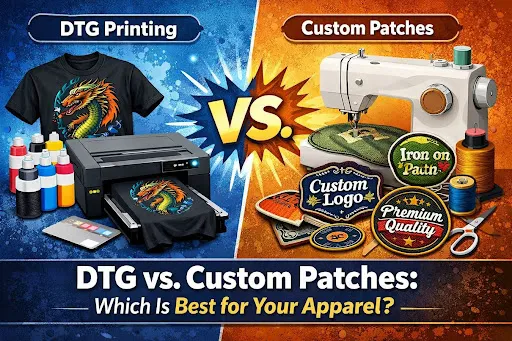
This guide debates all about direct-to-garment printing vs. custom patches, their pros and cons, and which one of the two is pocket-friendly.
What is Direct-to-Garment (DTG) Printing?
What does DTG printing mean? It stands for Direct-to-Garment Printing. This type of printing uses inkjet technology for fabrics.
In simple terms, to explain what DTG printing is, we have to break it down. It is similar to the way paper printers work. Instead of paper, DTG printing is a process where a printer is used for printing ink directly onto the surface of garments and fabrics, unlike custom patches, which are attached to the surface.
Reality of DTG Print Quality
In DTG printing, designs from digital files print directly onto fabric or garments. This method is great for high-resolution photos. The DTG print examples include realistic designs, complex designs, and vast color gradients. These are some things that traditional screen printing struggles with.
Is DTG Printing Worth It?
If you have made and are looking to sell, for example, the same design with 50 different colors, then the answer is affirmative. It has a low setup cost and allows for printing on demand. However, if you are looking for a rugged look for uniforms or high-end streetwear, custom patches are the way to go.
- Pros: When the budget is low but the detail needs to be high.
- Cons: Fades over time with wash and wear. Flat designs with no texture.
What are Custom Patches?
DTG may seem to win the speed game, but custom patches win the soul. They are artistic pieces made of fabric, leather, or plastic that can be attached to your garments or gear to give them a unique and personalized effect or could be used as a tool for branding. They are attached to the fabric or surface using patch backings like sewn-on, ironed-on, Velcro, PVC, or magnetic ones.
A Little More about Custom Patches
Custom patches are all about attaching texture, dimension, and longevity to the fabric. Custom patches offer a premium, tactile feel to the stuff they are applied on that you simply cannot get from any other method. Depending on the aesthetics of your brand, you can select from various types:
- Custom embroidered patches for a classic and textured look.
- Custom 3D embroidery patches for a raised and high-impact finish.
- Custom chenille patches for varsity jackets and soft/fuzzy textures.
- Custom leather patches are ideal for hats and luxury branding.
- Custom PVC patches have a durable, waterproof, and modern design.
- Custom sublimated patches are perfect for photographic detail on a patch.
Custom woven patches or custom silicone patches provide a crisp feel that even the best DTG printer can’t replicate. Furthermore, if you want something flashy, custom sequin patches or custom appliqué patches offer a level of customization that ink simply cannot match.
- Pros: It helps to repair the fabric with style and customization.
- Cons: Generally higher production costs Patches can peel off in case of selecting the non-ideal backing type.
DTG vs. Custom Patches: Key Comparisons!
| Feature | DTG Printing | Custom Patches |
| Texture | Flat and soft to the touch. | Raised, 3D, and varied. Examples are PVC, sequin, and leather. |
| Detail | Best for photos and gradients. | Best for bold logos and branding. |
| Durability | Fades over time with washes. | Extremely durable and often outlasts the garment. |
| Application | Printed directly on the fabric. | Could be ironed, sewed, or attached using Velcro. |
| Vibrancy | Vibrant but can look muted on dark fabrics. | Vibrant and has color consistency. |
The Verdict: Which One Should You Choose?
- Choose DTG: If you have a photorealistic complex design that you need to print with a soft feel on 100% cotton fabric. It’s the best low-budget yet high-detail alternative to custom-print embroidery.
- Choose Custom Patches: If you need premium-looking, durable designs for your favorite clothes or precious accessories. Additionally, you can present patches on different display items like shadow boxes and corkboards, or one can also attach them to items like bags, hats, or jackets for thoughtful personalization.
FAQs
Is DTG printing good?
Yes, for complex art designs that are not able to be achieved with custom patches.
Is DTG printing durable?
It depends on the garment quality and care during washing and wearing.
DTG shirts last for how long before fading?
DTG shirts can last up to 30 to 50 washes before the fading gets noticeable.
Are custom patches more durable and long-lasting?
Custom patches that are sewn on are more durable and sometimes last longer than the garment or gear itself. They are securely attached to the base as compared to DTG prints, which are printed on the garment surface and fade away with washing.
Putting an End to DTG vs. Custom Patches Debate
DTG vs. custom patches isn’t about which is better. Rather, it is about which one fits your vision. Whether you need the high-tech direct-to-garment printing, a definition of detailed and accurate design, or the classic feel of a custom woven patch, both will make your brand stand out.
To fulfill the custom patch purpose, The Eagle Patches USA is the name locals can trust. From your first brief till delivering the product right to your doorstep, we assist you in every step of the process.
Contact us today to bespoke your apparel with style and individuality that complements you!