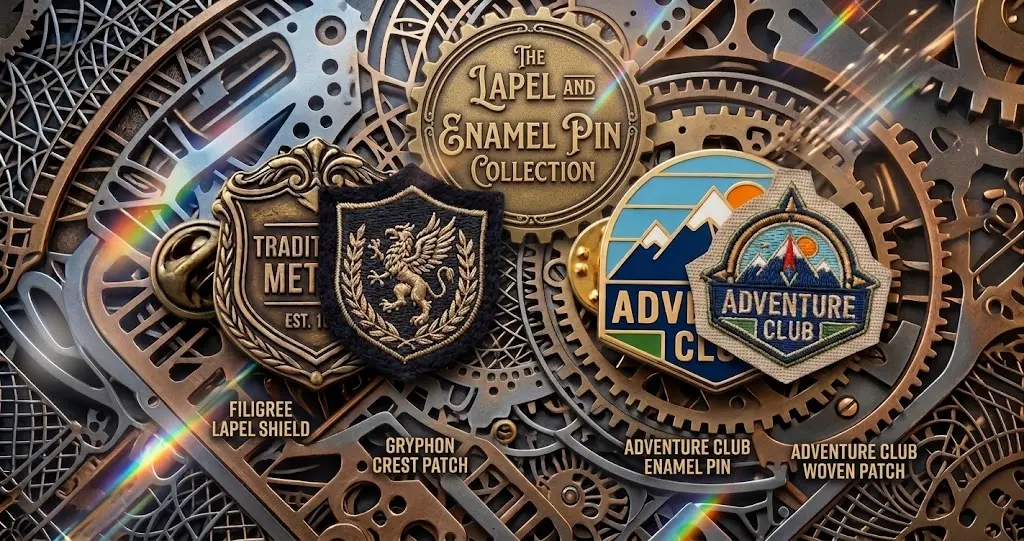
Someone asked me last week why their “enamel pin” order came back looking nothing like the “lapel pin” sample they’d seen at a friend’s office. Same shape, same general idea, totally different finish. That question is more common than you’d think.
Ask ten people to explain lapel pins and enamel pins and you’ll get ten different answers, a few close, a few confidently wrong, and one person who just shrugs and says “aren’t they the same thing?”
Quick version, before we get into the weeds: one of these terms describes a category, the other describes a manufacturing technique. It’s a bit like “shoes” versus “sneakers.” Every sneaker is a shoe. Not every shoe is a sneaker. Once that clicks, most of the confusion around lapel pins and enamel pins sorts itself out pretty fast.
What Are Lapel Pins?
A custom lapel pin is any small decorative pin worn on a jacket lapel, a collar, a hat, a bag strap. It describes where it’s worn, not what it’s made from.
They’ve been around for well over a hundred years at this point. Politicians wear them. So do veterans, corporate teams handing them out at conferences, country club members, scout troops. You’ll find die-struck pins, cloisonné pins, screen-printed ones, and yes, enamel pins too.
When someone brings up the difference between lapel pins and enamel pins, the answer is, enamel pins are one type of lapel pin. Just a sub-category that happens to be extremely popular right now.
What Are Enamel Pins?
This one’s about process, not placement. A design gets stamped into metal, the recessed areas get filled with colored enamel, and then the whole thing gets baked, polished, and plated.
That’s roughly the journey from a flat metal sheet to the little pin sitting on your desk, You’ll mostly run into two versions of this:
- Hard enamel pins. The enamel gets filled, baked, then polished down flat, so the surface feels smooth, when you run a finger over it.
- Soft enamel pins. The enamel sits just below the metal lines instead of flush with them, which gives it that slightly raised, textured feel a lot of people actually prefer.
Both count as enamel pins. Technically, both are lapel pins too, since they get worn the same way everything else in this category does, clipped to a collar, a hat brim, a bag strap. Also emphasises on the ultimate clean and care guide for enamel pins, specifically.
Where This Mix-Up Actually Comes From
“Enamel pin” turned into the trendy catch-all phrase you’d see on Etsy or Instagram, while “lapel pin” kept its older, more formal reputation from business attire and military uniforms. At The Eagle Patches USA, you’ll find your customised lapel pins being styled according to your needs, which most retailers fail to deliver.
How Retailers Blurred the Line
Custom enamel pins were the language of Etsy and Instagram for a while, but “lapel pin” still had its more buttoned-up connotations of business wear and military uniforms.
A lot of retailers and a lot of manufacturers confuse these terms all the time, because the average shopper just wants a pretty colorful pin and doesn’t give a rat’s ass what it’s technically called.
Why It Matters When You’re Actually Ordering
When you’re out there comparing lapel pins and enamel pins for an actual order, you’re not choosing between two rival products.
You’re choosing between a broad category and one specific look inside it, and that distinction matters a lot more once real money and a deadline are involved.
Lapel Pins and Enamel Pins: The Core Difference, Laid Out
Here’s the side-by-side version, since sometimes a table just says it faster than a paragraph can.
| Feature | Lapel Pins (General Category) | Enamel Pins (Specific Style) |
| Definition | Any pin worn on a lapel, collar, or bag | A pin made with colored enamel fill |
| Includes | Die-struck, cloisonné, enamel, screen-printed | Just hard enamel and soft enamel |
| Color method | Varies by style | Enamel fill, baked and polished |
| Texture | Smooth, raised, or flat depending on style | Smooth (hard) or textured (soft) |
| Best for | Corporate, military, fashion, awards, basically anything | Colorful logos, mascots, detailed artwork |
| Typical material | Metal, alloy, zinc | Metal base with enamel color fill |
Once it’s laid out like that, it stops feeling like a trick question. Enamel pins are just one branch on a much bigger tree.
How to Actually Apply This When You’re Placing an Order
Knowing the difference on paper is one thing. Using it when you’re staring at an order form with a deadline breathing down your neck is another. Here’s how that plays out in practice.
Start with what you want the pin to look like.
Bold, cartoonish, lots of clean color blocks? You’re probably looking at enamel. Want something more formal, metallic, crest-like company logo or military insignia? You might want die-struck or cloisonné instead.
Then think about texture, because it matters more than people expect.
Some people like that flat, glassy hard enamel finish. Others prefer the slightly raised, tactile feel of soft enamel. There’s no wrong answer, it’s genuinely a preference thing, but it’s worth deciding before you approve a proof, not after the pins show up.
Factor in where the pin is actually going to be worn.
A boardroom setting usually calls for something classic and understated. A band’s merch table or a gaming convention booth? That’s enamel pin territory, loud colors and all. It also guides about the comprehensive explanation on how to keep your enamel pins from falling off accurately.
Last step, get a digital mockup before anything goes into production.
At The Eagle Patches USA, we send a proof first so you can tweak colors, size, and backing before it’s actually manufactured. It’s a standard part of how we run every custom pin order, precisely so nothing shows up looking different from what you approved.
A Few Quick Corrections Before You Order
- Stop assuming “enamel pin” and “lapel pin” are two separate products, one’s a style, the other’s the umbrella category
- Ask your manufacturer directly which enamel type, hard or soft, actually fits your artwork
- Get a digital proof before you approve full production, always
- Match the pin style to the mood of the event, formal settings usually want die-struck, casual ones usually want enamel
- Double-check the backing type (butterfly clutch, magnetic, safety pin) based on how it’ll actually be worn
- If it’s your first time with a new manufacturer, order a small sample batch before committing to a big run
- Keep artwork simple and bold, fine detail tends to disappear once a design shrinks down to pin size
What You Actually Gain From Getting This Right
It’s easy to treat the lapel pin versus enamel pin distinction as a minor detail, something you can sort out later or just wing based on a gut feeling.
Understanding lapel pins and enamel pins before you hit “order” is a genuinely practical step that protects your budget.
You Save Real Money
Picking the correct production method on the first attempt, instead of the second, means you’re not paying for a redo. Getting the texture or finish wrong the first time around usually means eating that cost and starting over.
You Save Time, Too
Fewer emails back and forth trying to explain why the sample doesn’t match what was in your head. Fewer delays waiting on revised proofs. The whole process just moves faster when everyone’s aligned from the start.
Your Final Product Actually Matches Your Brand
A pin that’s supposed to feel polished and professional shouldn’t end up looking playful by accident, and vice versa. Choosing the right style upfront keeps the finished piece consistent with the tone you were actually going for.
The Pin Looks Right in Person and in Photos
There’s a real difference between a pin that’s “close enough” and one that wears and photographs exactly how you pictured it. That gap usually comes down to whether the texture, color method, and finish were chosen correctly from the start.
Where Each Style Actually Shines
Different settings call for different styles, and matching the right one to the right occasion makes a bigger visual difference than most people expect.
| Occasions | Recommended Pin Style | Why It Works |
| Corporate Events | Die-struck or hard enamel lapel pins | Clean, professional, long-lasting shine |
| School Clubs & Scouts | Soft enamel pins | Colorful, budget-friendly, fun designs |
| Military & Veteran Groups | Die-struck or cloisonné lapel pins | Formal, durable, traditional look |
| Bands & Fashion Brands | Hard or soft enamel pins | Bold colors, collectible appeal |
| Gaming & Pop Culture Merch | Soft enamel pins | Playful shapes, character-friendly designs |
| Awards & Recognition Programs | Die-struck lapel pins | Elegant, timeless, formal presentation |
Why Consider The Eagle Patches?
Not all of them bother explaining the difference before taking your payment, which is half the reason for this article.
If the project actually matters, a corporate rollout, a school fundraiser, a band’s merch drop, working with people who understand the technical side of lapel pins and enamel pins saves you from a lot of expensive guesswork later.
Free Design Support, No Catch
Their team helps turn a rough sketch, a logo, or even just an idea scribbled on a napkin into an actual pin concept, and they don’t tack on extra fees for it. You’re not paying separately for the design work before you even get to production.
Custom Lapel Pins and Custom Enamel Pins Under One Roof
No need to shop around five different vendors just to get both styles quoted. Formal die-struck design, bright enamel one, doesn’t matter, it’s all handled by the same team, in the same place.
You See It Before It’s Made
Every order comes with a digital proof first. That means you’re looking at the real thing, colors, layout, sizing, before it goes anywhere near a production line, not after it shows up in a box you can’t send back.
Made and Inspected in the USA
Quality control happens domestically, and every batch gets checked before it ships. That matters more than people realize until they’ve dealt with a supplier that skips this step entirely.
Fast Turnaround, Low Minimums, Real Support
Most orders ship in under two weeks, with rush options available if you’re cutting it close. Minimums stay low enough that a small order doesn’t get brushed off, and when you actually have a question, someone on their team answers it instead of steering you toward the priciest option.
Frequently Asked Questions
Does the category of lapel pins come under enamel pins?
No, enamel’s just one option. You can also find die-struck, cloisonné, and screen-printed lapel pins, each with a different look and finish.
Which holds up better, hard enamel or soft enamel?
Hard enamel tends to win out here, which sits more textured and exposed.
Can I combine different pin styles in a single bulk order?
You can, The Eagle Patches are fine with mixed styles in one order.
Are enamel pins more expensive than standard lapel pins?
That’s less about the style label and more about the design itself, it is about how much detail it has and how many colors go into it.
What’s the typical turnaround for a custom pin order?
Once your design’s approved, plan on roughly 7 to 14 business days before it ships.
Do I need to meet a minimum order size?
No, The Eagle Patches sets the bar low, so smaller batch orders are easy to place.
Do I get to preview my design first?
Yes, there’s a free digital mockup sent over before anything goes into production.
Picking the Right Pin for Your Project
Lapel pins are just the catch-all term, basically any small pin you’d pin to a jacket or collar falls under it. Enamel pins are one piece of that puzzle, the colorful one, not something separate trying to steal the spotlight.
Once that relationship actually clicks, ordering gets a lot less stressful. Working with a team, like The Eagle Patches USA, that explains the difference upfront, that’s the part that makes the whole process understandable, from first sketch to final shipped box.