Picture a conference room, a wedding, or a fourth of July parade downtown. Someone’s jacket catches the light and there it is, a small pin sitting on the lapel. Nothing loud about it, but it’s clearly not there by accident.
That little thing actually says something about the person wearing it. Could be their company, their unit, their team, or just something they’re proud of. Nobody has to explain it either, the pin’s already telling you everything you need to know.
This is basically why custom lapel pins never really go out of style. Businesses use them, schools use them, clubs use them, families use them at weddings.
A little piece of metal and enamel keeps showing up everywhere from corporate dinners to military ceremonies to campaign booths, and there’s a reason for that.
In this guide, we’ll get into what these pins are, the different styles out there, how to actually use them the right way, and why the manufacturer you pick matters more than most people assume going in. A lot of this is based on how The Eagle Patches USA actually walks customers through the process.
What Exactly are Custom Lapel Pins?
Custom lapel pins are small pins you wear on a jacket or blazer lapel. Plenty of people stick them on hats, bags, or lanyards too, really wherever there’s fabric to clip onto.
Built from Metal, Finished with Custom Detail
Metal is the base, and from there it gets dressed up, enamel, paint, or plating, then locked down with a backing so it actually stays on a jacket.
The word “custom” is what pulls it out of novelty-pin territory. Instead of grabbing something off a shelf, you’re deciding the shape, the colors, the font, the finish, all of it built around one specific brand, team, or moment.
Used Differently Across Every Group
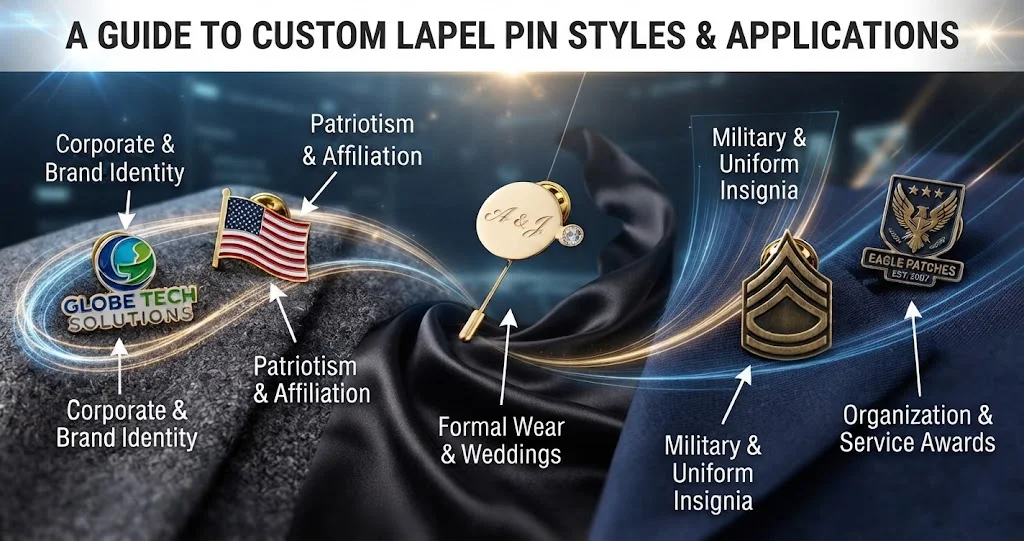
Businesses use them to build recognition, while military units use them to mark rank and honor.
Wedding parties use them to add a personal touch to formalwear, and collectors use them simply because they’re fun to trade and display. Each group finds its own reason to wear one.
One Thread Ties Every Use Together
The common thread across all these uses is identity, these small accessories are one of the things that allow someone to wear their story on their chest.
It doesn’t matter if it’s a brand, a rank, or a memory being represented. The meaning is always personal, even when the pin itself is small.
Core Differences Between Types of Lapel Pins
Pins don’t all come off the same production line, and the way one’s made tends to shape both its look and what it’s actually good for. The Eagle Patches USA works with a handful of these styles, and lined up side by side, the differences get pretty easy to spot.
Enamel Lapel Pins
This is probably the style most people picture first. Metal lines separate blocks of color, and the whole thing gets a glossy coat that makes it pop under light. Logos, club badges, retail giveaways, enamel handles all of it with ease.
Printed Lapel Pins
When a design has too much going on for enamel to keep up with; gradients, fine detail, or a photo-heavy logo, then printed lapel pins take over. It’s basically full-color reproduction squeezed onto a tiny surface, and it’s the only real option once a design gets complicated.
Acrylic Lapel Pins
These feel different in the hand too. Lighter, a little more playful, sometimes even clear or translucent depending on the design. Younger crowds tend to gravitate toward these types of pins more.
Suit Lapel Pins
Not every pin is designed to make a statement. Suit lapel pins are understated, sleek, minimal, adding a subtle touch of character without drawing unnecessary attention. That restraint is particularly suited to a business suit or at a wedding, where the outfit should remain the main focus.
Flower Lapel Pins
These take more craft than most pin styles bother with, petals shaped and textured so light hits them unevenly instead of bouncing off one flat surface. Mostly shows up at weddings, as a boutonniere, or just extra detail on formal wear.
Award Lapel Pins
Polished metal, sometimes engraved lettering, built specifically to mark a moment rather than just decorate a jacket. Companies lean on these for service milestones and employee recognition because they offer a meaningful way to celebrate achievements.
Military Lapel Pins
Precision matters more here than almost anywhere else. Rank, unit, insignia, every detail has to be exact, since these pins carry real meaning tied to service and honor. You’ll see them across the armed forces and at veteran ceremonies, worn with a level of care.
Flag Lapel Pins
Simple in concept, national colors and symbols rendered in miniature, but that simplicity is what makes them work. Offices, campaigns, patriotic events, anywhere someone wants to show pride, a flag pin does the job effectively.
Why are These Pins Worth the Investment?
In practice, these pins solve problems organizations actually face such as recognition, budget constraints, and keeping people connected.
They Build Instant Recognition
Put a branded lapel pin on every team member at a trade show, and it’ll do more for brand recall than a whole stack of business cards. Cards get shoved in a drawer and forgotten.
A pin, though, people actually see, on your chest, in every conversation, in every photo. That’s the kind of visibility that makes pins such a solid branding tool.
They Create a Sense of Belonging
Whether it’s a motorcycle club, scout troop, or sales team that just hit quota, the result is the same. Hand everyone the same pin, and somehow a bunch of individuals start feeling like one team.
It’s just a small object, but it carries more weight than that for identity and pride. People wear it because, deep down, it’s proof they belong somewhere.
They’re an Affordable Way to Say Thank You
Award lapel pins run a fraction of what a plaque or trophy would cost, but somehow they still hit just as hard emotionally.
Maybe it’s because pinning something to your chest feels more personal than parking it on a shelf where it collects dust. Either way, it’s one of the cheapest, easiest ways to actually recognize people on a regular basis.
They Travel Well and Last for Years
Unlike a banner or piece of signage, a pin goes wherever the wearer goes, meetings, flights, dinners, and everywhere in between.
A well-made metal lapel pin for business use can last for years without fading, chipping, or bending. That combination of portability and durability is hard to beat.
How to Use Custom Lapel Pins the Right Way?
Where people either nail it or completely fumble is in the design, the placement and the actual rollout. Here’s how The Eagle Patches USA walks clients through that part of the process, step by step.
Step 1: Nail Down Your Purpose First
Before you sketch anything, decide what the pin needs to communicate. A pin meant to reward five years of service needs a different tone than one handed out at a music festival. Intended function shapes every detail, ranging from colour palette to size to metal finish.
Step 2: Pick the Right Pin Type and Finish
Once the purpose is clear, match it to a pin style. A corporate rollout usually calls for clean enamel lapel pins or custom suit lapel pins in a subtle plating like shiny nickel or golden brass. A festival or fan giveaway can make a bigger statement with acrylic or printed designs.
Step 3: Send Over a Sketch or Logo
You don’t need a polished vector file to get started. The Eagle Patches USA accepts a rough sketch, an existing logo, or even a doodle and turns it into a workable design during the art stage.
Step 4: Review the Digital Proof
Before anything gets produced, you’ll receive a digital mockup showing exact colors, thread or enamel placement, and layout. This is the stage to request tweaks, sizing adjustments, color corrections, or font changes, so the final batch matches your vision exactly.
Step 5: Choose Your Backing
Backing decides how comfortable and secure a pin actually feels once it’s on. Delicate fabric that shouldn’t be punctured usually calls for magnetic backing, while a safety pin does the job fine for something quick and temporary, like a single-day event.
Step 6: Wear and Place Them Correctly
Military lapel pins usually sit above medals or ribbons depending on the uniform protocol, while a suit lapel pin traditionally goes on the left notch of the lapel itself. If there’s more than one pin involved, keep the main one centered and just space the rest out evenly, symmetry looks a lot better than a cluttered jacket.
Step 7: Distribute With Intention
Handing out pins at a company’s meeting or a wedding rehearsal dinner works better when there’s a small moment attached to it, a short explanation of what the pin represents. That little bit of context turns a giveaway into a token people actually hold onto.
Where These Pins Get Used Most?
| Setting | Typical Pin Style |
| Corporate offices & trade shows | Enamel or suit lapel pins |
| Military ceremonies | Military lapel pins |
| Weddings | Flower or suit lapel pins |
| Motorcycle & hobby clubs | Enamel or acrylic pins |
| Company events & galas | Branded lapel pins |
| Employee recognition | Award lapel pins |
| Political campaigns | Flag or printed pins |
| Schools & scouting groups | Enamel or printed pins |
Which Industries Use Lapel Pins, and on What Fabrics?
Not every workplace dresses the same way, and the fabric a pin sits on changes what backing and weight actually work. Whichever industry you’re in, custom pins can match backing and add finish to the garment.
Here’s how the major industries break down by garment fabric and the pin style that suits each one:
Corporate & Business Suits (Wool, Wool-Blend, Polyester Blazers)
Office lapels are usually wool or a wool-poly blend, sturdy enough for a clutch-back pin without sagging. Suit lapel pins and clean enamel designs in shiny nickel or golden brass fit right in at client meetings, conferences, and executive headshots. (See the difference between enamel pins and lapel pins when deciding between finishes.)
Military & Government Uniforms (Twill, Gabardine, Polyester-Wool)
Dress uniforms hold up to a lot, mostly because they’re made from tougher fabric like twill or gabardine that can take repeated pinning without wearing thin. That’s exactly why military lapel pins, with their precise detailing and traditional plating, get worn above ribbons or medals per uniform code, the fabric’s built to handle it.
Wedding & Formalwear (Silk, Satin, Tuxedo Wool)
Silk-faced jackets and tuxedo lapels are delicate fabric, plain and simple. They go easy with suit lapel pins or flower lapel pins here. Stick to a magnetic or rubber back and the fabric stays pinhole-free.
Hospitality & Retail Uniforms (Cotton, Cotton-Poly Blend)
Generally, retail uniforms and front-desk uniforms are made of cotton-poly and cotton material. A clutch back or safety pin holds up better under that than a magnetic pin, which tends to loosen and fall off after enough wear.
Motorcycle & Denim Club Wear (Denim, Leather)
Denim and leather are thick enough to anchor something bigger like the enamel, acrylic, without the fabric stretching out or tearing the way lighter material would.
Schools & Scouting (Polyester Blend Blazers, Sashes)
Lightweight blazers and fabric sashes pair well with smaller printed or custom enamel pins secured with a simple clutch or safety pin, since younger wearers prefer easy application and removal.
Common Corrections to Consider:
A few small mistakes come up again and again with first-time pin orders. Keep these in mind before you submit your design.
| Mistake | Correction |
| Overcrowding | Try to keep it simple. |
| Wrong plating | Match plating to the setting. |
| Wrong backing | Match the backings to the fabric. |
| Skipping proof review | Always review digital proof. |
| Inconsistent placement | Keep placement consistent. |
Frequently Asked Questions
How should a lapel pin be worn?
Left side, above the heart. Old rule, still the right one.
What are custom lapel pins actually used for?
Pins are commonly used for these purposes such as branding, marking an achievement, showing team or club pride, backing a cause.
Can you wear more than one lapel pin at once?
Just don’t crowd the lapel, instead center your main pin.
What type of lapel pin works best for a formal event?
Enamel or metal pins suit the formal event best.
How are military lapel pins traditionally worn?
On the left side, above any medals or ribbons that’s standard per uniform guidelines.
Where exactly does a pin go on a suit?
On the left notch lapel keeps things clean and professional-looking.
What’s the real benefit of going custom instead of buying generic pins?
It’s stronger branding, it feels more genuine, and custom pins just hold up better than the mass-produced stuff over time.
How long does a custom pin order usually take?
About one to two weeks once you’ve approved the design proof.
Custom Lapel Pins: The Small Detail That Makes a Big Impact
Custom lapel pins actually signify what impact such small details do create. Either you’re preparing a sales team for a big push, sending an officer off after years on the job, adding a personal touch to a wedding party, or just handing out something people will actually keep at the company gala.
It doesn’t matter the occasion. That pin says who you are before you’ve said a single word. Figure out what the pin’s for before you get into finishes or colors and reach out to The Eagle Patches USA for placing your orders.
Go with something that fits the occasion, not just whatever catches the most light and actually check the proof, that’s usually where you catch a mistake before it’s too late to fix.