Your backpack goes everywhere. That means any patch you slap on it gets dragged through car seats, airport floors, lockers, rain, and the occasional “oops” moment. So if you want a patch to stay put, sewing is the move. No peeling, no edge curl, no patch falling off mid-semester like it’s trying to escape.
How to Sew a Patch On a Backpack
Pick the Spot First or You’ll Regret It Later
Before you thread a needle, check what’s behind the fabric. Backpacks have linings, padding, laptop sleeves, and secret pockets that will absolutely get in your way.
Choose a flat area with some breathing room. Avoid thick seams, zippers, and curved edges where the fabric bunches. If you can reach the inside of the bag easily, you’re in a good spot. If you can’t, you can still sew it, but it’ll take more patience.
Choose the Patch Type That Fits the Job
Most people go with an embroidered patch for that classic look. Woven patches work great if your design has small text or fine lines. PVC patches are tough for outdoor backpacks and rough use. Leather patches look clean and premium. Chenille patches are bold and varsity-style but thicker to sew through. Applique and sequin patches are more fashion-forward. Sublimated patches are great for full-color designs.
No matter the style, for a backpack you’ll usually want sew-on backing or at least sew it down even if it came with iron-on glue.
Get the Backpack Ready So Sewing Is Actually Possible
Empty the bag. Like fully empty. Pen caps and random keys love to poke you at the worst time.
If the bag has a lining you can pull aside, do it. You don’t want to stitch the front panel to the inner pocket by accident. If you can’t move the lining, slide a piece of cardboard inside the backpack behind the area you’re sewing. That gives you a firm surface and helps protect the inside layers.
Now place the patch and use pins or fabric clips to hold it. If you’re worried about holes in the bag fabric, clips are safer than pins.
Stitch Choice That Holds up on Backpacks
For backpacks, you want stitches that don’t quit. A whip stitch around the edge is simple and strong. A blanket stitch looks nicer and also locks the edge down well. If you want it extra clean, use a straight stitch close to the border and go around twice.
Use strong thread. Regular sewing thread works, but thicker thread is better on heavy fabric. Match thread color if you want it subtle, or contrast it if you want the custom patch to pop.
Sew It on Without Fighting the Bag
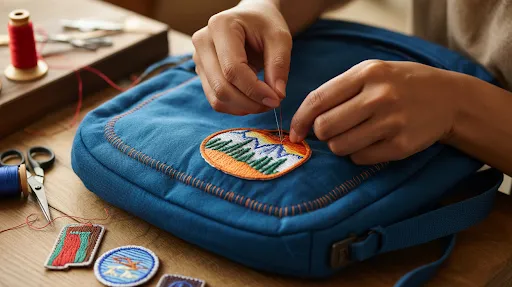
Thread your needle and knot the end. Start from the inside of the backpack panel if you can, so the knot is hidden.
Push the needle through to the front near the patch edge, then stitch around the border. Keep stitches evenly spaced and snug, but don’t pull so tight that the fabric puckers. If the patch edge lifts, your stitches are either too far apart or too loose. If the fabric bunches, you’re pulling too hard.
When you hit a thick spot, don’t force it. Wiggle the needle through slowly and use a thimble or the back of a spoon for pressure. Backpacks are tough. Your fingers don’t need to suffer for fashion.
Once you’ve stitched all the way around, tie off your thread on the inside with a tight knot. If you want extra security, run the thread through a few stitches before knotting, then trim the excess.
If you also want a cleaner finish style for other gear, the jacket version of this “How to Sew a Patch on a Jacket and Make It Look Awesome” guide is helpful for stitch ideas and neat borders.
Things to Look Out For!
Don’t sew through the laptop sleeve or inner pocket. Always check the inside before you start and as you go. Also, don’t place patches on areas that fold constantly, like right on the bottom corners. That flexing wears thread down faster.
FAQs
Can you sew a patch on a backpack with an iron-on backing?
Yes. You can ignore the glue and sew it normally. Sewing is what makes it stay long-term on a backpack.
What’s the strongest stitch for a backpack patch?
A whip stitch or blanket stitch around the edge holds up well. Going around twice makes it even stronger.
Do you need a special needle for backpacks?
A thicker needle helps on heavy fabric. If the backpack is very tough, a heavy-duty needle makes the job much easier.
Will sewing ruin the backpack fabric?
Not if you stitch near the patch edge and avoid ripping stitches out repeatedly. Take your time and you’ll be fine.
Now Your Backpack Has a Personality Upgrade!
That’s how to sew a patch on a backpack so it stays put through real life. If you want patches made for heavy use, with clean borders that are easy to stitch, The Eagle Patches USA can help you get the right patch style for your bag and your design so it looks sharp and holds up.