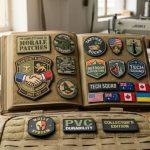
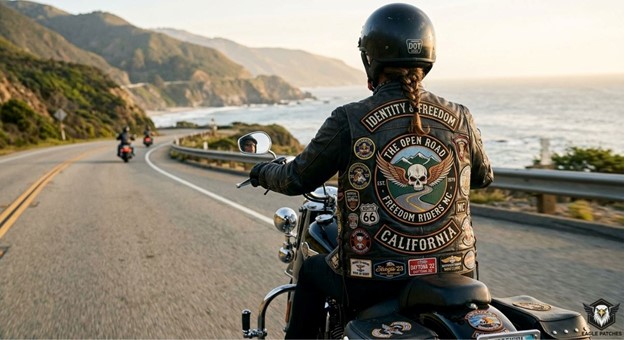
An open road provides riders with an unrivaled sense of freedom. Riders have searched for ways to enhance their individual experience on the open road through various forms of self-expression, and a notable and long-standing way to do so is through the use of motorcycle patches. These patches are used primarily as ornamental items, but they also have profound meanings.
Patches tell stories of a rider’s journey, ties with groups, values/beliefs, and personal achievements. Whether a solo rider is travelling on a Saturday morning or an active member of a motorcycle club is in line for a coffee. Anyone who sees the rider with patches on their vest knows there is a story behind each patch.
Different types and meanings of these custom motorcycle patches can be fully understood, but it is important to look deep into their long history, how they are created, and the proper etiquette for wearing them. It started with the biker culture in the US and has grown into a global community of riders who create their own patches to express themselves. With the development of custom patch and branding industries, motorcyclists have more choices for personalizing their custom patches.
This guide will give you an understanding of the entire motorcycle patch experience, from the history of patches and how they are made to the proper etiquette surrounding them, so you will be able to design, purchase, and wear your motorcycle patch with pride and an understanding of its significance as part of your riding heritage.
The Deep-Rooted History of Biker Culture and Insignias
The tradition of adorning riding gear with insignias traces its roots back to the period immediately following World War II. When veterans returned home, they created riding clubs as an outlet for the camaraderie and adrenaline they missed from their time in the service. Many of these original riding clubs created designs based on the military patches that had been used to identify their unit in the armed forces. These original designs were very basic. Many were simply painted or hand-sewn onto these veterans’ old military uniforms or jackets.
As time passed, and motorcycle culture grew and evolved into different subcultures, the designs of the colors, or patches, became more complex and held much more meaning. For example, the American Motorcyclist Association estimated that ninety-nine percent of motorcyclists were law-abiding citizens, which contributed to the outlaw motorcycle clubs’ adoption of the “1%” diamond insignia. This created a massive historical event that helped to define what a patch represented.
It was not just a riding club identifier but became a hugely significant symbol of the person’s life and philosophy. While the hardcore motorcycle clubs have and continue to hold on to rigid rules regarding their colors, the broader motorcycle community has welcomed the aesthetics with open arms, which has led to a tremendous explosion of personal and unaffiliated designs within the motorcycle community.
While the creation of the post-World War II patches through highly stylized, computer-generated designs is a direct result of the technological advances in the garment embellishment industry, the underlying need for bikers to identify themselves with their other fellow bikers in the community has remained constant.
Understanding the Significance of Emblems Today
Today’s embroidery designs are no longer simply for membership in a club, but for many, their leather vests serve as a representation of all the two-wheeled experiences they have had throughout their lives. There are leather jackets decorated with commemoration patches from large events such as Sturgis or Daytona, patches to identify special charity rides, and clever, witty patches that express the personality of the owner.
Many riders also wear memorial patches to remember friends and family who have passed away, making what may be thought of as just a piece of apparel into a powerful memorial. Additionally, the increase in rider groups that are based on the make of the motorcycle, type of riding, or even profession has created a large community of different iconography.
Adventure riders may have flags from countries they have ridden through displayed, while vintage cafe racers may create a patch that has a minimalistic, traditional style. The differences in sewn patches will ensure that no two vest designs are ever the same. The custom patch market has boomed due to the amount of personalization possible. Riders are searching for unique patches, just like the custom motorcycles they build and ride.
Popular Materials and Styles Used for Riding Gear
Motorcyclists encounter an extremely challenging environment that includes rain, wind, UV sunlight, and road debris all affecting their riding gear, so any materials used to produce the patches/badges that are put on the garments will need to be exceptionally durable. The custom patch and branding industries have various manufacturing techniques, each having its benefits, depending on the intended aesthetic and the intended use.
Traditionally, embroidered thread is the material of choice for patches because it has excellent texture and depth and provides a classic, vintage appearance. Woven patches are created with finer threads that result in more detailed artwork and smaller lettering than using embroidery.
Modern materials have recently entered the riding community. Polyvinyl chloride (PVC) is a type of plastic that resembles rubber. It is very durable, completely waterproof, and does not fade. Therefore, PVC patches are the best option for serious touring riders who may be exposed to harsh weather.
Leather, either through laser engraving or embossing, will have the rugged, premium look necessary to complement traditional motorcycle vests. All three materials will react differently to the elements and need to be properly cared for to maintain their appearance over time.
| Material Type | Primary Advantages | Best Suited For | Durability Level |
| Traditional Embroidery | Classic texture, depth, high perceived value, and traditional biker aesthetic. | Standard club logos, rally commemoratives, and name tags. | High |
| Woven Thread | Extremely high detail, precise small lettering, smooth surface profile. | Complex artwork, photographic reproduction, intricate logos. | High |
| Polyvinyl Chloride (PVC) | Completely waterproof, highly UV resistant, and a modern three-dimensional look. | Adventure touring, all-weather riders, and tactical styling. | Extreme |
| Genuine or Faux Leather | Rugged appearance, natural aging process, premium feel. | Vintage enthusiasts, subtle branding, and luxury riding gear. | Very High |
| Chenille | Fuzzy, vintage texture reminiscent of letterman jackets. | Retro designs and novelty fashion pieces. | Moderate |
Navigating the World of Custom Motorcycle Patches
If the ready-made designs do not meet your requirements, then it is time to explore the creation of custom motorcycle patches. Here, you get the full freedom to decide on anything related to the patch, including its dimensions, color scheme, and material used for the backing and borders. Be it for a new group you have recently created or as a means of generating revenue in a motorbike repair shop, this approach guarantees you a unique design for a huge central piece on your vest.
The first important step in the customization of your patches is the determination of their principal purpose. Do you need them for visibility, or are these supposed to be funny patches for the pockets of a denim jacket? The desired location determines the size of the patch and its backing as well.
For example, in case you plan to change these patches often from one jacket to another, the hook-and-loop backing will serve best for this purpose while an unchanging patch for a durable leather cut needs a more robust backing. It is best when working with a reliable manufacturer specializing in this niche.
The Design Phase: Crafting Your Unique Rider Identity
Balancing creative and artistic considerations with the technical realities of production becomes essential when creating an engaging visual asset. A graphic that appears fantastic on-screen may fail on fabric due to excessively small detail work or poor color choice that makes colors bleed when set next to each other.
Vector graphic programs are strongly advised for their ease of scalability and precise line work that digitizers can effectively understand. Consider the structure of information while developing ideas for the design. Bold, sans-serif typography and high-contrast color combinations like bright yellow on black or stark white on deep red are incredibly effective when trying to read something from afar, as in the case of a rocker’s name being embroidered on the back.
Color gradient usage is discouraged, as traditional embroidery uses solid colors. In the cases when gradients are unavoidable, then woven or printed methods must be considered. Finally, the symbolism behind any particular imagery is important to consider from a cultural perspective in terms of not accidentally copying outlaw biker graphics.
How to Make Custom Motorcycle Back Patches: A Step-by-Step Overview
The most outstanding feature of the embellished motorcycle vest should definitely be the massive patch attached to its back. Knowing exactly how to make custom motorcycle back patches involves several steps, which help turn your creative artwork into something massive and stitched to reality. For massive back placements, it requires more attention and accuracy compared to the smaller embroidered patches on the front part because of the patch size and high patch costs.
First of all, you need to finish up with the masterpiece. As back designs can reach the width of ten to fourteen inches, they provide much space for illustrations, banners, and even fancy font styles. Then comes the digitizing stage. This step is a highly complicated operation and needs a specially trained team of patch makers who are going to map out the course of action of an industrial embroidery machine with many needles.
The team will have to decide on the direction of stitches, their density, and placement in order not to ruin the fabric with puckers and provide your work with strength. Otherwise, even the best-designed back patch won’t be able to hold together. After the digitizing process, the manufacturer will produce an actual pre-production sample or digital mock-up. It is essential at this stage.
You should check whether the threads used correspond to your brand requirements, as well as make sure that all details are reproduced correctly. Then the design goes to a large-scale production process, which involves big embroidery machines with many needles that put the design into real patches. Next, the borders are completed and are usually made of a reinforced, double-stitched Merrow border.
Preparing the Artwork and Sizing Your Masterpiece
Another crucial consideration when creating an effective back piece is proper design and patch sizing. A design that is too small will completely dwarf the huge area on which it will have to be displayed on a leather vest, while the latter can pose problems such as discomfort from covering the sides and interfering with the rider’s ability to sit comfortably.
It is considered standard practice to size a main piece somewhere in the range of ten to twelve inches in width, depending on the dimensions of the garment to which it will eventually be attached.
In the process of preparing the artwork for printing purposes, a mockup will have to be created. One has to print their design using actual sizes on standard paper, cut the resulting design, and paste it to the actual back of the vest or jacket intended for application.
In case of a standard three-piece set where the pieces include a top rocker, the main artwork, and a bottom rocker, the latter two have to frame the middle piece without any overlap.
Proper Placement and Etiquette for Independent Riders
Though riders of all kinds enjoy a vast amount of freedom to create something unique and personalized, being able to understand the traditional guidelines/patch etiquettes when it comes to the arrangement of patches will result in the creation of an aesthetically pleasing vest that is well-balanced. Planning for vest layout design is important and requires thoughtful organization to make sure that every piece has enough space to get noticed.
In general, the front side of a vest features relatively small patches, with some exceptions that will be made clear below. The left chest is a place where name tags, primary club affiliations, or even memorial pieces are located. On the other hand, the right chest can feature rally pieces, funny sayings, or secondary club affiliations.
Finally, the back side of a vest is where everything happens. For those who do not belong to a traditional multi-piece club, using one large piece will be the best solution. Awareness regarding the three-piece patch, consisting of the top rocker, the club logo, and the bottom rocker denoting the territory, is vital because this particular combination belongs only to the traditional and dominant motorcycle clubs.
Individual riders and other bike clubs normally avoid using these patches so that there will be no mix-ups when riding on the streets. In this regard, using 1 or 2 piece patches without making any claims for territories is advised. This way, the hierarchy of broader motorcycle clubs is respected, and enthusiasts can display their artwork with pride.
| Vest Location | Common Usage and Placement Guidelines |
| Upper Left Chest | Name tapes, road names, primary allegiance, and highly personal items. |
| Upper Right Chest | Rally attendance markers, humorous slogans, secondary affiliations. |
| Lower Front Pockets | Brand logos (e.g., Harley-Davidson), small decorative elements. |
| Upper Back | Large independent centerpieces, major brand logos, custom artwork. |
| Lower Back | Commemorative ride banners, memorial rockers (non-territorial). |
Application Methods: Sewing vs. Ironing on Leather and Denim
After receiving your custom work, the last step you must complete is to have your part fully attached to your riding gear, which is the installation process itself. Although many patch makers and vendors will supply you with designs that can be applied through a heat-sealing process, the general feeling among riders regarding this approach is that it is not strong enough to survive in a motorcycling environment.
When it comes to jackets made out of denim or light-weighted canvas, sewing is the most dependable way. It involves using an industrial-strength home sewing machine that has a denim needle and some heavy-duty upholstery thread. However, when you are dealing with thick cowhide or buffalo leather vests, then applying any form of patches to them requires special tools. Most common sewing machines lack the ability to penetrate both the leather and heavy-duty embroidery backing at once.
As this can cause serious damage to both your sewing machine and needle, what you need to do is to bring your garment and patches to a cobbler, leatherworker, or even motorcycle apparel store. These experts have industrial-strength walking-foot sewing machines meant to sew heavy leather perfectly.
Caring for Your Embellished Riding Vests and Jackets
However, cleaning decorated apparel will have to be handled differently from ordinary laundry. It involves special techniques that will ensure that there are no damages to your clothes. Spot cleaning will be better for your denim or canvas vest as compared to using a machine to launder it completely.
In cases where you really need to use a machine, then you should make sure that you use cold water on a delicate setting. Moreover, you should not put such clothes in a hot dryer.
There is a need for special care when handling leather gear. Nothing from either the leather or the embroidered sections should ever get into contact with water or be machine washed. Instead, one needs to use a wet cloth to wipe away any form of dust or dead insects found in either the leather or embroidered parts.
Where it becomes difficult to clean the dirt using a damp cloth, then the help of a soft toothbrush together with some form of mild soap should be used. Leather requires special conditioners to keep it from drying up and cracking. This process requires extreme caution since oils can affect the embroidered thread color.
The Evolution of Patch Culture in Modern Motorcycling
The world of motorcycle attire is constantly evolving along with the technological progress in production and demographic shifts in the community. At present, there is a unique combination of traditional design with technological innovations. Motorcyclists order elaborate pieces with reflective elements in their clothing to be safe at night, combining functional properties and artistic design.
Moreover, there is a renaissance of traditional manufacturing methods such as chainstitching and chenille, as riders attempt to recreate the romanticism of the 1940s and 1950s. Additionally, the digital revolution allows for the development of unique designs. It is not necessary to go to sporting goods stores nearby or browse catalogs to order clothing anymore.
Riders can establish direct communication with manufacturers from abroad or work with digitizing studios and patch makers locally to create customized designs that could never have been produced previously because of financial considerations. Hence, the practice of creating custom patches in textile art will be preserved and thrive for many more years to come.
Frequently Asked Questions
What is the best way to attach a patch to a thick leather vest?
Sewing is the most secure and permanent method.
Which patch material is best for extreme weather and heavy touring?
PVC is highly recommended because it is entirely waterproof, durable, and UV-resistant.
What is the standard size for a custom motorcycle back patch?
Main centerpieces typically range between 10 and 12 inches wide to properly fit a standard vest.
Can I safely machine wash my patch-covered riding gear?
Spot clean leather only, but denim can be safely washed inside out on a cold, delicate cycle.
Preserving the Heritage While Embracing Modern Customization
It is impossible not to acknowledge the symbolism associated with the open road, and the clothes one wears while traversing this highway of life are a perfect manifestation of one’s freedom and unique personality. Be it the leather jacket of an experienced long-distance rider or custom denim vest decorated with motorcycle patches. Each patch is an indicator of distance covered and unforgettable experiences gathered along the way. The ability to navigate the fine art of materials selection and the design process will enable you to fully experience this ritual.
Regardless of whether you have to tackle such a complicated task as the design of a massive back patch to be embroidered on jackets of all the members of your club or you just wish to make some small patch as a token of memory, the amount of work spent will result in the creation of a garment that means much to you personally. Even as new opportunities arise, the core motivation of people decorating their clothes never changes.
After reading our detailed guide, if you are planning to order your patches online, head over to Eagle Patches USA today. We offer high-quality and durable patches that are exactly in accordance with your design in mind. Get a free quote with us today!