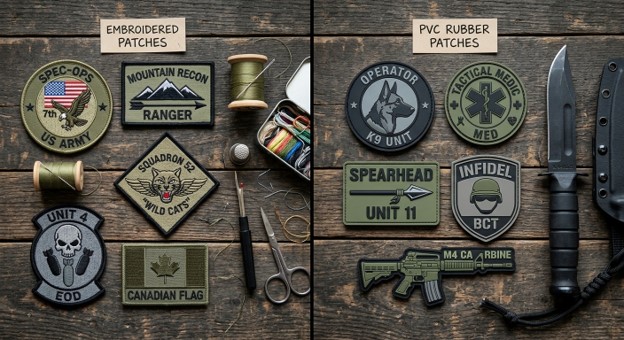
Have you ever tried to order custom patches? Then you would probably be hitting the same fork in the road. Should I order embroidered or PVC?
They both look great, both have a long-lasting time, and both appear everywhere from custom military uniforms to biker jackets.
They’re built quite diversely, basically, they behave differently, and they’re suited for different specific jobs. This means that picking the wrong one doesn’t indicate an incorrect decision.
But picking the right one actually saves and manages your money and hassle and is a much better choice as compared to a patch that gets peeled off after one rainy hike.
This is the area that breaks down the actual differences between embroidered and PVC patches in order for you to make a confident decision.
In addition, it makes it clear that you’re either outfitting a police department, branding a specific motorcycle club, or just want a cool patch for your backpack and accessories.
What Are Embroidered Patches?
Embroidered patches are the ones that have classic choices. The ones you grew up seeing and alluring on Boy Scout sashes, varsity jackets/hoodies, and army custom uniform patches as well.
They’re fantastically made by stitching the colored thread onto a fabric backing, usually which is set to be twill.
In order to build up a design that is raised in textured detail, the thicker the stitching, the more that 3D, tactile feel you get with it.
Custom embroidered patches are popular because they carry a timeless, traditional outlook and image.
There’s a reason uniforms, workwear outfits, and heritage brands give more priority to embroidery. It feels quite premium and authentic in a style that other patch types struggle to match.
The stitching also gives the chosen design real texture, which photographs very well and feels good under your fingers.
Depicting the fact that embroidery has limits: such extremely fine detail, tiny text, or very complex gradients can get lost in the stitching pattern.
In addition to this, the thread can sometimes be so thin, so if your logo has delicate linework, some of that nuance may not translate perfectly as required.
What Are PVC Patches?
PVC patches (polyvinyl chloride) are molded from absolute soft, flexible rubber-like material instead of standard stitched thread. Hence, the design is poured into a mold, layered in vivid color and put to be finished within a raised, glossy, almost cartoon-like 3D effect.
Relate to it by thinking of tactical gear patches, morale patches, and gear you’d see strapped upon a backpack or a plate carrier.
Custom PVC patches shine and look flawless when a design needs bold colors, sharp edges, or intricate small details that embroidery can’t hold onto.
Due to this reason, the material is made up of essentially waterproof rubber, PVC patches shrug off rain, mud, and sweat without a second thought.
This is a big reason they’ve become in demand for outdoor and tactical gear.
The main tradeoff that occurs is the texture. For this reason, the PVC patches don’t have that much classic stitched look.
They’re glossy and rubbery, which some people find to be interesting and others find too “plasticky” for formal uniforms or heritage branding looks.
Embroidered vs PVC Patches: Key Differences Noted
Appearance and Texture Styles
This is usually the first thing people notice and denotes to be the most vital factor. Embroidered patches vs PVC patches couldn’t look more different up close.
Embroidery has raised the bands for thread texture, a fabric feel, and the one with traditional quality. On the other hand, PVC patches are smooth, glossy, and bold, with a distinctly modern, 3D look.
If you want to buy a patch that feels classic, think of custom military patches, police badges, or company uniforms, embroidery usually wins on appearance.
This is the statement that defines the perspective that adds value to the look. If you want something that emerges with color and looks eye-catching from a distance, like on tactical vests or motorcycle gear, PVC has the edge.
Durability
Both patch types are built to last, but they hold up differently depending on where they’re suitably utilized. For this reason the embroidered patches are tough and can handle regular washing.
However, the thread can fray or fade over years of heavy wear, especially with harsh detergents or long sun exposure sourcing. This is depicted from the fact that The Eagle Patches USA is the best platform that assesses it.
PVC patches are practically indestructible in comparison. The molded rubber material resists the cracking, fading, and abrasion. It doesn’t fray at the edges the way thread can.
When looking at the PVC patches vs embroidered patches durability, PVC generally outperforms in rough, high-friction environments.
Water and Weather Resistance
In order for your patches to survive rain, mud, snow, or ocean spray, this is where PVC patches are essentially made waterproof by design.
Essentially, when looking at the water beads’ features, the rubber surface, there’s no fabric to soak through or mildew it.
Embroidered patches, on the other hand, are made of thread and fabric, so they absorb moisture effectively.
They’ll survive the rain very well, but they take a longer time to dry and can hold onto dirt or odor if they stay wet for a longer time.
For anyone comparing embroidered vs PVC patches for outdoor use, PVC is the safer choice.
Cost
The cost/budget factor matters, especially for bulk orders. When it comes to PVC patches vs embroidered patches costing, the pricing strategy depends heavily upon the design complexity and order size.
Embroidered patches are often more cost-effective for simple designs with fewer colors, since the process is well administered and more efficient at scale.
PVC patches can cost a bit more per unit, especially for smaller runs, because of the molding process that is involved.
Detail and Design Complexity
Want to get the intended logo with fine lines, tiny text, or a photorealistic gradient? PVC patches vs embroidered patches, PVC will usually capture it more accurately and have a defined edge.
The basic design is molded rather than stitched. Moreover, the PVC can hold onto sharp edges and small details that thread simply can’t replicate or replace.
Embroidery is phenomenal for bold shapes, lettering, and classic logos. Also, it starts to struggle once the design gets intricate.
If your artwork is detail-heavy, PVC is generally the safer choice when making the decision.
However, for highly detailed, multi-color designs, PVC can be more economical than the ones trying to replicate the same complexity in thread. It’s worth getting a quote on both if cost is your decision factor domain.
Embroidered or PVC Patches: Which Is Better for Specific Uses and Application?
There’s no specific single stated “best patch type”, it really depends on what you’re making the patch for.
Embroidered vs PVC Patches for Uniforms
For police, fire, corporate, or school uniforms, custom embroidered patches tend to be more professional and traditional.
The custom uniform patches in embroidery carry that classic, respected look that’s expected in formal settings environments.
Embroidered vs PVC Patches for Jackets
Custom jacket patches can go in either way depending entirely on the vibe. A technical or outdoor jacket might suit the bold, weatherproof look of PVC.
For instance, the leather jacket or denim one gives a vintage, rugged aesthetic feel and often looks better with embroidery.
Embroidered vs PVC Patches for Tactical Gear
This one leans PVC almost every time. Constant movement, abrasion, and mud can be endured by the custom tactical patches.
Due to this reason, the differentiated nature of PVC makes it waterproof, flexible, and the standard choice for morale patches, tactical vests, and outdoor gear.
Embroidered vs PVC Patches for Outdoor Use
If a patch is going to be exposed to the elements regularly like on hiking gear, boat gear, camping equipment, then PVC appears to be the more practical option due to its durability and water-resistant nature.
Are Embroidered Patches Better Than PVC Patches?
When considering the durability in rough environments and fine detail assessments, the PVC patches have a win-win situation.
Embroidered patches stand out on a classic texture, traditional stitched appearance, and cost-efficiency factors for simpler designs.
So which is better, embroidered or PVC patches? It genuinely comes down to your use case scenario, the look that you are searching for, and the environment the patch that will dwell in day to day operations.
How to Choose Between Embroidered and PVC Patches
Here’s a simple way to think it through when comparing these types of custom patches:
Choose the required Embroidered Patches When:
Your design is relatively simple with text alignments or bold shapes, when you want a classic textured look for the branding, workwear or uniforms.
Choose PVC Patches When:
Your patch needs to survive water, mud, marks, or heavy outdoor use, or your design has fine detail and multiple colors that need to stay sharp and vivid.
Considering Your Budget Constraints:
Simple designs often require embroidery that can be costly. Due to this reason, complex, colorful designs may favor PVC.
Think About Where It’s Worn:
Formal uniforms lean embroidered, while tactical, outdoor, or gear-focused applications lean on PVC.
Personalized Patches for Events:
Both works well, so let the design style and material feel guide your choice of direction.
Can You Mix Embroidered and PVC Elements?
The use of embroidery for the text and a separate PVC patch for the graphics element actually shows a design that portrays bold icons and word marks.
If you’re not sure enough which material to commit towards, you should ask your patch maker for samples of both, so you can effectively compare the texture and weight before placing a bulk order.
FAQs
Do I have to choose one type, or can one supplier make both?
You can mix materials in one order without the need to match colors or setting timelines with the suppliers. The Eagle Patches makes both in-house, along with woven, chenille, and sublimated options.
Is PVC really more durable than embroidered patches?
Yes, the PVC molded rubber actually resists mud, water, and abrasion better than any stitched thread, as the fabric absorbs moisture quite well.
Are PVC patches more expensive at eagle patches than elsewhere?
The Eagle Patches keeps bulk pricing competitive at scale, unlike suppliers who charge a premium for smaller custom runs.
Do other patch companies have order minimums for both types?
The Eagle Patches actually keeps the minimum order limit low across both the PVC and embroidered patches. This way small businesses and individuals do not require hundreds of units to unlock the decent pricing domain.
Which One to Choose, Embroidered or Pvc?
The texture versus the durability and the tradition versus the toughness highlights the differences between embroidered and PVC patches very effectively.
For a classic feel for the uniform and heritage brands, embroidered patches add a timeless craftsmanship.
PVC patches, on the other hand, bring in bold color, modern durability, and waterproofing nature that suits real-world use.
From free design proofs to fast turnaround, a good patch partner will help you land on the best patch type for your project. Reach out to the expert, The Eagle Patches USA team, and get your chosen patches made in a perfect style.