A custom patch looks small, but there’s a whole mini production line behind it. If you’ve ever wondered what happens after you hit “order,” here’s the real play-by-play.
Behind The Scenes How Custom Patches Are Made At The Eagle Patches USA
Step One Your Artwork Gets Patch Ready
Your logo might look perfect on a screen and still need a little cleanup for thread, weave, or rubber.
This is where your file gets checked for the usual troublemakers: tiny text, thin lines, gradients, and low resolution images. You may get a quick suggestion like “make this line thicker” or “drop the tiny tagline” so the final patch stays readable.
If you’re sending a clean vector file, you’re already ahead. If not, no stress. The goal is simple: make your art look sharp when it becomes a real object you can hold.
Step Two You Pick The Patch Type That Fits The Job
This is the part where “cool” meets “useful.” Your patch type should match where it’s going and what it needs to survive.
Here’s a quick snapshot:
- Embroidered patches for that classic raised texture and bold logos
- Woven patches when you need crisp small text and fine detail
- PVC patches for weather-friendly, wipe-clean durability
- Chenille patches for varsity style jackets and big bold looks
- Leather patches for a premium, understated vibe on hats and workwear
Your design also influences the choice. A detailed badge might look cleaner as woven. A bold icon can look perfect embroidered.
Step Three Digitizing Or Stitch Planning Happens
If you choose embroidered patches, your artwork needs to be translated into stitch instructions. That process is called digitizing, and it decides how your patch will actually look.
This is where stitch direction, stitch density, and stitch types get planned so your patch doesn’t look flat, messy, or overstuffed. It’s also where details get adjusted so letters don’t turn into tiny thread noodles.
For woven and sublimated styles, it’s still about planning the build so lines stay clean and colors stay true.
Step Four Backing Gets Matched To How You’ll Use It
A patch can be perfect and still fail if the backing is wrong. Backing decides how the patch attaches and how long it stays put.
Common options include:
- Sew-on backing for long-term wear and frequent washing
- Iron-on backing for quick application on the right fabrics
- Hook and loop backing for removable patches on uniforms and gear
- Adhesive backing for temporary placement and short-term use
If your patch is going on a uniform or a backpack that gets used daily, durability matters more than convenience.
Step Five Production And Finishing
Now the patch gets made based on the chosen style.
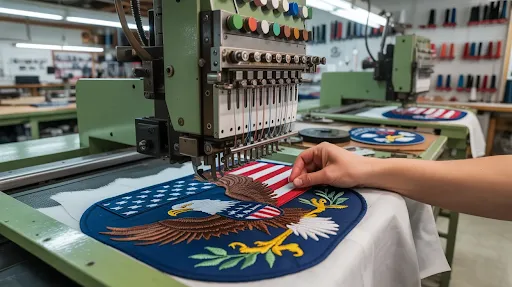
For embroidered patches, machines stitch the design onto a base twill. For woven patches, the design is woven with thinner thread for detail. For PVC, molds and layered material create that 3D look. For chenille, thicker yarn gives the fuzzy varsity finish.
Then finishing happens. Borders get cleaned up, shapes get cut precisely, and edges get reinforced. You’ll typically see options like a classic merrowed border or a stitched border depending on shape and detail.
Step Six Quality Check Before It Leaves
This is the moment that separates “good enough” from “looks professional.”
A proper check includes color accuracy, clean edges, readable text, and backing alignment. If anything looks off, it gets caught before it ships. You want the patch you approved, not a surprise.
Step Seven Packing And Delivery
Once the batch is approved, patches are packed to stay clean and flat. Then they’re shipped out ready for uniforms, jackets, hats, bags, or your next event drop.
If you want the simple step-by-step on placing an order the right way, this guide lays it out clearly: How to Order Custom Patches from The Eagle Patches USA.
FAQs
What file type works best for custom patches?
Vector files are best, but a high resolution PNG can work if it’s clean and sharp.
How long does it take to make custom patches?
It depends on patch type, quantity, and artwork detail. The proof stage is usually the key step that sets everything in motion.
Which patch type is best for small text?
Woven patches usually handle small lettering better than embroidered patches.
Is sew on backing better than iron on backing?
Sew-on is usually better for frequent washing and long-term wear. Iron-on is faster for quick application on compatible fabrics.
Ready To See Your Patch Come To Life
Behind the scenes, it’s all about getting your design built the right way, with the right patch type, backing, and finish so it holds up in real life. When you’re ready, The Eagle Patches USA can help you go from idea to a clean, professional patch set that looks consistent and wears well.