
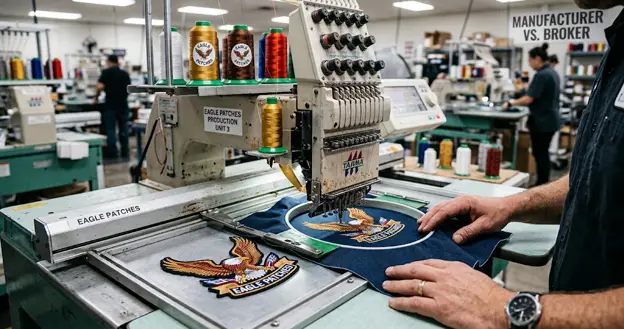
If you have looked into sourcing custom patches for your company’s uniforms, you might have seen a lot of similar-looking websites promising factory-direct pricing, in-house production, and expert craftsmanship.
These promises seem to come from an army of manufacturers, yet most do not appear to have factories.
But that doesn’t mean these companies are scams—some brokers do good work. However, for certain projects—including security/public safety teams, sports leagues, brand merchandise launches, and more—it’s important to make sure the company you are paying actually makes their products.
In this guide, we’ll help you distinguish between a real manufacturer and a broker by showing you the differences between them, asking the right questions, and showcasing true in-house manufacturing capabilities.
We’ll even go over common mistakes to avoid when working with manufacturers. Let’s start by defining the terms.
Why it matters who actually makes your patches
Producing a single patch isn’t necessarily easy. It is just some little bit of embroidery on fabric — but if you want it to retain its shape, be vibrantly colored, and match your artwork, then there are dozens of choices to make.
How do we digitize our artwork? What kind of threads will go into this patch? At what density should we stitch? With what kind of stabilizers? How do I cut or merrow my borders? Finally, how should we apply our backings?
All of these things have been managed by someone who actually works physical jobs at the machine themselves. When you partner up with the company that also runs the machines themselves, they can bring those benefits to you too.
- Accountability. If the red in your logo comes out orange, there is one team responsible and one team that can fix it. When an order passes through a broker, you report the problem to the broker, who reports it to the factory, who may or may not agree there is a problem.
- Consistency across reorders. Custom embroidered patch manufacturers who keep your digitized file, thread colors, and production notes on record can reproduce your patch exactly next year. A broker may send the same artwork to a different factory next time, and the result can look noticeably different.
- Honest timelines. A manufacturer knows its own machine schedule. A broker is guessing, relaying a promise made by someone else. Rush orders in particular depend on someone who controls the floor.
- Better pricing. Every layer between you and the machine takes a cut. Direct production removes at least one margin from the equation, which becomes very noticeable on bulk orders.
Signs you are dealing with a broker
There isn’t any single sign that will prove anything by itself, but together they make up an important signal. Here’s how to find those signs as you compare your patch suppliers.
Stock photos and generic imagery
Real ones are messy and busy things. If all the pictures of this factory show you are seeing polished-up products with machines that look exactly alike, then don’t waste your money. Try doing a quick reverse image search on a couple of their pictures.
No named people
A genuine manufacturer usually has a production manager, a digitizer, a quality lead, somebody whose name and role appear on the site. Brokers tend to hide behind “our team” and “our experts.”
Vague location language
Phrases such as “our partner facilities,” “our global network of factories,” or “trusted production partners” are common broker wording. A manufacturer will usually tell you where the work happens.
One page, every product
When you go to your local pin broker (the type that sells everything from embroidered, woven, PVC, chenille, leather, and enamel), he’ll likely tell you anything you ask him to. You’ll have no idea if these are made in-house. On the other hand, real manufacturers are very clear on what types of products we do best.
Evasive answers about digitizing
Digitizing is the step where your artwork is converted into stitch instructions. It is a skilled job, and it is done at the start of production. If a supplier cannot explain who digitizes your file, where, and how revisions are handled, it is likely not being done in-house.
Unrealistically flexible everything
Zero minimums, instant quotes on any design, and six-day delivery on every product may be possible, but when every promise is maximum, and no constraint is ever mentioned, someone else is probably absorbing the risk and may not be able to keep the promise.
Reviews that never mention production
When you read custom patch factory reviews, look past the star rating. Do customers mention the factory, the proofs, the stitching, the communication with the production team? Or only the website and the checkout? Reviews that describe the product itself, how the patches looked, and how they held up after washing.
Appropriate Questions to ask any supplier
You do not need to be an expert in embroidery to test a supplier. You only need a few direct questions, and the quality of the answers will tell you most of what you need to know.
- “Do you own the machines your patches are made on, and where are they located?” A manufacturer answers immediately and specifically. A broker tends to pivot to “our facilities.”
- “Who digitizes my artwork, and can I see the digitized file or a stitch preview before production?” In-house digitizers can show you a preview and make changes quickly.
- “Can you send a photo or short video of my actual order on the machine?” This is the single most revealing request. A real factory can do it the same day, because someone is standing beside the machines. A broker has to ask someone else, and may not be able to deliver.
- “Can you tell me about your process if our final patches do NOT look like the proof that we approved?” – You want to know how they’ll handle errors, either by reproducing or replacing or giving you a credit, and within what timeframe.
- “What are your minimum order quantity, standard turnaround, and rush options, and what makes each possible?”A good vendor should be able to walk through why their quantities are set as such
- “Can I speak with the person managing my production?” If a supplier will connect you with a production manager, that is a good sign.
- “Can you provide references or examples from customers similar to me?” A supplier that has genuinely produced work for uniform programs, clubs, brands, or resellers can usually share relevant examples.
Keep the answers. If two suppliers quote similar prices, the one that answered these questions most clearly is almost always the safer choice.
Our production: digitizing, machines, and mockups
At Eagle Patches, the work that decides whether a patch looks right happens under one roof. Here is what that looks like from the moment you send us artwork.
Step 1: Artwork review and digitizing
Every order begins with your artwork, whether that is a vector logo, a rough sketch, or a photo of an existing patch. Our digitizer converts it into a stitch file, deciding the stitch types, direction, density, and underlay for each part of the design. Fine text, thin lines, and small details are monitored carefully at this stage.
Step 2: Proof and approval
You receive a proof showing the layout, size, thread colors, and border style. Nothing moves to the machines until you approve it. Changes at this stage are quick because the person adjusting the file sits next to the person who will run it.
Step 3: Thread selection and setup
Thread colors are matched to your brand colors as closely as possible and loaded onto the machine. Stabilizer, backing material, and border type are set according to the approved proof.
Step 4: Embroidery on our own machines
Your patches are stitched on machines we operate, supervised by operators who know the file. If a thread breaks or a color needs correction, it is handled at the machine, not through a chain of emails.
Step 5: Cutting, merrowing and backing
After embroidery, patches are trimmed or finished with a merrowed border, then fitted with the backing you chose, such as iron-on, hook and loop, sew-on, or adhesive.
Step 6: Quality control
Every batch is inspected against the approved proof. We check stitch quality, color accuracy, border consistency, size, and backing adhesion. Defective pieces are pulled before packing.
Want the full walkthrough with more detail on each stage? Read our guide to how custom patches are made at Eagle Patches.
Pricing and turnaround differences
Price and speed are the two areas where the broker vs. manufacturer difference shows up most clearly.
Pricing:
A broker’s price includes the factory’s price plus the broker’s margin. On small orders, the difference may be modest. On bulk orders, it can become significant. That is one reason direct manufacturers are often better value for larger runs.
If you plan to order in volume, whether for employees, members, retail, or resale, see our bulk custom patches options for details on quantity-based pricing.
| Pricing Domain | What to Watch For | Why It Matters |
| Low end of range | Quotes far below average | Cheap often means cut corners |
| Thread usage | Thin or less thread | Weaker durability |
| Stitch density | Fewer stitches | Lower detail and quality |
| Backing fabric | Inferior backing | Less stability and lifespan |
| Labor quality | Unseasoned workers | Inconsistent workmanship |
| Quote comparability | Different specs per quote | Prices can’t be compared fairly |
Turnaround:
When working through brokers, there will be some added time involved as orders are passed along.
If you’re dealing with manufacturers who manage their own schedule, you’ll likely get greater precision around how long things take to produce — and much greater flexibility when adjustments come up.
Ask any supplier how long they’ll require between production and shipment times, and what steps you’d have to take to qualify for a rushed production window.
Reorders:
A manufacturer that stores your files can typically reproduce an order faster and with fewer questions. Ask whether your digitized file and thread specifications are saved after the first order.
Problem resolution:
The real cost difference often appears when something goes wrong. With a direct manufacturer, a reprint is a decision made accurately.. With a broker, it may be a negotiation.
FAQ
What is the difference between a patch manufacturer and a broker?
The manufacturer owns all of their manufacturing equipment; they employ everyone who does the digitizing and produces your patches; they own/control the product quality, and they are accountable for meeting schedules. A patch broker is the one who passes along orders to a third-party factory; you lose some control over what happens next.
How can I tell if a custom patch supplier actually has a factory?
Ask for a photo or short video of your own order running on their machines, and ask who digitizes your artwork. Look for named staff, a stated location, and original photography rather than stock images. Suppliers with real production can answer quickly and specifically.
Are patch manufacturers cheaper than brokers?
We often have cheaper quotes for larger quantities – as there’s one less margin to pay. Always compare identical specifications (size, thread cover, border, back).
Is it a red flag if a supplier uses partner factories?
Not always, but it should definitely be disclosed. When companies put up banners saying “Factory”, and yet outsource all aspects of their work, it’s concerning.
How do I evaluate custom patch factory reviews?
Reviews mentioning things like stitching quality, color accuracy, how they communicate with the production team, deadlines, and how any problems have been solved can help you find better matches. Check several review sites.
Do I get a proof before my patches are produced?
At Eagle Patches, yes. You receive a proof showing the layout, size, thread colors, and border for approval before production starts. Any reputable patch supplier should offer the same. If a supplier skips proofing, treat it as a warning sign.
See how we make patches
We would rather verify our claims than take our word for them. Ask us for photos of your order on the machine, speak with our production team, and compare our answers with anyone else’s.
Start with our homepage to see what we produce, or explore bulk custom patches if you are planning a larger order. When you are ready, send us your artwork, and we will show you exactly how your patches would be made.